Most Affordable Tools for Tracking Customer Health Scores (2026)
Most Affordable Tools for Tracking Customer Health Scores (2026)
Published

Lucia Ordonez
Marketing Intern
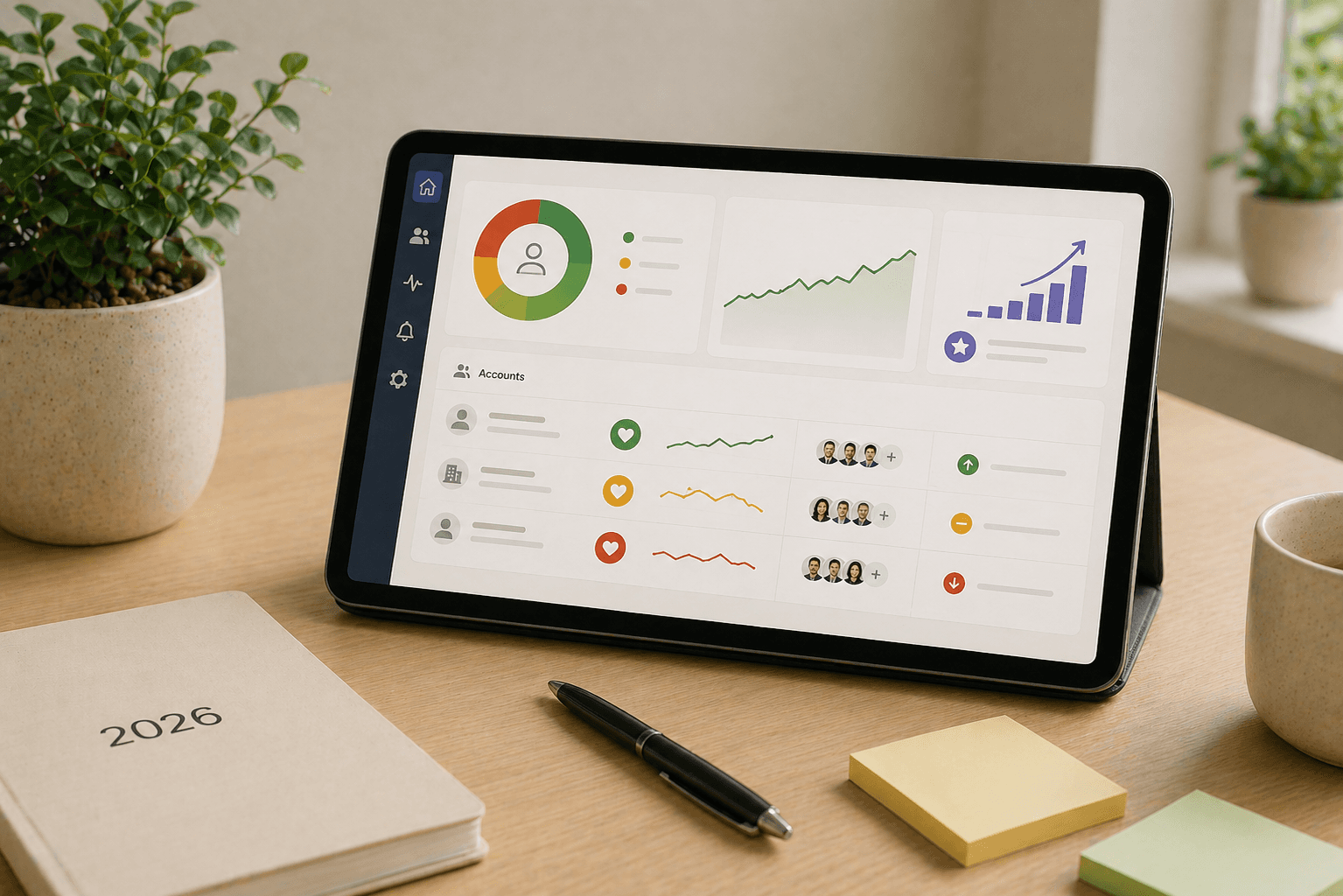
Customer health scores have become essential for B2B SaaS teams seeking to predict churn risk and identify expansion opportunities through systematic analysis of product usage, engagement patterns, and account activity. For growing B2B companies, customer health score tools automate the collection and analysis of customer data, transforming raw metrics into actionable health scores that help teams prioritize outreach and intervention. Costs vary significantly based on features, team size, and platform complexity, making careful evaluation crucial for teams with budget constraints. This comprehensive guide examines the most cost-effective customer health score solutions available in 2026, comparing implementation approaches, pricing models, and core capabilities across platforms designed for different organizational stages. Whether you're an early-stage startup managing dozens of accounts or a growth company overseeing hundreds of customers, you'll find practical evaluation criteria to select tools that deliver meaningful insights without overwhelming operational overhead. While enterprise platforms like Gainsight offer comprehensive functionality, they may be complex for small- and mid-market teams, creating opportunities for modern alternatives like Userlens to serve teams seeking account-level analytics with streamlined deployment. Userlens exemplifies the AI-native approach to customer intelligence, focusing specifically on what customer success teams need: automated health scoring, proactive alerts, and seamless integration with existing analytics infrastructure. Unlike traditional product analytics platforms designed primarily for product teams, Userlens treats companies and users as distinct entities, enabling true account-level analysis that customer success managers require for effective portfolio management.
TL;DR
Resolving issues quickly is widely associated with higher customer retention.
Affordable health score tools like Userlens focus on account-level analytics, AI-powered scoring, and real-time alerts, essential for lean CS teams managing 100s to 1,000s of accounts
Traditional enterprise CS platforms (Gainsight, Totango) require months-long implementations and dedicated ops teams, while modern alternatives deploy in days by connecting to existing analytics stacks
Pricing models range from free tiers for startups to usage-based plans under $500/month for mid-market teams, with significant cost savings compared to $50k+ annual enterprise contracts
The right tool balances affordability with critical capabilities: health scoring methodology, CRM sync, proactive alerts, and onboarding speed for non-technical teams
Introduction
Customer churn costs B2B SaaS companies far more than they realize. Acquiring a new customer costs 5 to 25 times more than retaining an existing one, yet many early-stage teams lack the tools to predict and prevent churn before it happens. Customer health scores, composite metrics combining product usage, engagement frequency, and support interactions, have become essential for proactive retention. However, enterprise customer success platforms often price out startups and growth-stage companies with $50,000+ annual contracts and complex implementation timelines. This guide evaluates the most affordable customer health score tools built for lean customer success teams. We'll compare pricing models, implementation complexity, health scoring methodologies, and startup fit across solutions ranging from free plans to mid-market options under $500/month. Whether you're a VP of Customer Success managing 200 accounts or an early-stage founder wearing multiple hats, you'll find practical evaluation criteria and transparent cost comparisons to select the right tool. Userlens serves as a featured example throughout, an AI-native customer intelligence platform built for B2B SaaS teams that need account-level insights without enterprise overhead. Unlike traditional product analytics tools (Amplitude, Mixpanel) designed for product teams, Userlens focuses on what customer success teams actually need: automated health scoring, proactive churn alerts, and CRM-synced usage data. With deployment timelines measured in days rather than months, Userlens exemplifies the modern approach to affordable, accessible customer health tracking. The platform's AI health scores evaluate accounts against criteria defined in natural language,understanding seasonality and business context that rule-based systems may not fully capture. This guide will help you choose the tool that fits your budget, team size, and operational maturity.
What to Look for in Affordable Customer Health Score Tools
Not all customer health score tools are created equal, especially when budget constraints force tradeoffs. The right affordable solution balances cost with core capabilities that directly impact retention and expansion revenue.
Health Scoring Methodology
The foundation of any customer health tool is how it calculates health scores. Traditional systems use rigid, rule-based scoring that assigns fixed weights to metrics like login frequency or feature adoption.This approach can become harder to maintain when customer behavior varies by industry, seasonality, or use case. Modern alternatives like Userlens's AI-driven health scores allow teams to define what "healthy" means in natural language. The AI evaluates accounts against custom criteria, understanding context that static formulas miss. For example, a financial research platform might see usage spike quarterly during earnings season — AI scoring recognizes this pattern rather than flagging accounts as at-risk during natural lulls. When evaluating tools, ask: Can I customize scoring logic? Does the system account for account-specific context? How quickly can I adjust weights as my product evolves? Affordable tools often limit customization to pre-set templates, while more sophisticated options provide flexibility without requiring data science expertise.
Account-Level vs. User-Level Analytics
This distinction separates customer success tools from product analytics platforms. Product analytics tools (Amplitude, Mixpanel) excel at tracking individual user behavior — valuable for product teams optimizing feature adoption. Customer success teams, however, manage company accounts, not individual users. Account-level analytics aggregate usage across all users within a customer account, revealing patterns like champion dependency (one power user carrying the account), broad vs. narrow adoption, and team-level engagement trends. When a key stakeholder leaves, account-level views immediately surface the risk. Userlens treats companies and users as first-class objects, allowing CS teams to ask account-centric questions: "Is this enterprise customer using Reporting across departments?" rather than "How many report_created events fired?" Budget-conscious buyers should verify whether a tool provides true account rollups or forces manual aggregation of user-level data.
Implementation Speed and Technical Requirements
Legacy enterprise CS platforms require 3-6 month implementations, dedicated customer success operations headcount, and custom instrumentation. For teams without engineering resources, this timeline kills momentum. Affordable tools should connect to your existing data infrastructure with minimal setup. Userlens integrates with Segment, Amplitude, Mixpanel, and PostHog no new event instrumentation required. Teams go live in days, not quarters. When evaluating tools, ask: Can non-technical CS managers configure the system independently? What's the realistic time-to-first-insight? Do I need engineering support for ongoing maintenance? The best affordable solutions prioritize accessibility, allowing customer success operations leaders to own the system without analyst bottlenecks.
Proactive Alerts and Automation
Dashboard-based tools require CSMs to check health scores manually — a reactive model that misses early warning signs. Real-time usage analytics and alerts transform customer success from reactive to proactive. Userlens sends Slack alerts on cohort membership changes, churn signals, expansion triggers, and health score shifts, converting from "dashboard you check" to "system that tells you what to do." This automation is critical for teams managing large account portfolios. A single CSM might oversee 200+ accounts alerts ensure they focus on the 5-10 requiring immediate attention. Look for tools that support customizable alert logic, multi-channel delivery (Slack, email, in-app), and workflow automation triggered by usage thresholds.
Pricing and Affordability Comparison
Understanding total cost of ownership requires looking beyond sticker price to implementation costs, required headcount, and hidden fees. Here's how affordable options stack up against enterprise alternatives.
Solution | Starting Price | Implementation Time | Best For | Key Limitation |
Userlens | Custom (usage-based) | Days | B2B SaaS teams needing account-level analytics without analyst dependency | Requires existing analytics stack (Segment/Amplitude/Mixpanel) |
HubSpot Service Hub | 1-2 weeks | Teams already using HubSpot CRM for sales and marketing alignment | Basic health scoring in lower tiers; advanced features require Professional+ ($90/seat) | |
Zendesk | $55/agent/month | 2-4 weeks | Support-first teams prioritizing ticket management over proactive CS | Health scoring add-ons increase costs; primarily support-focused |
Vitally | Vary depending on complexity and internal resources | 2-3 weeks | Mid-market teams with dedicated CS ops resources | Higher minimum spend; manual data pipeline setup |
Gainsight | Vary depending on complexity and internal resources | 3-6 months | Enterprise teams with complex workflows and dedicated ops teams | Prohibitive cost and implementation timeline for early-stage companies |
The pricing disparity between modern and legacy platforms is stark. Enterprise solutions like Gainsight charge $50,000+ annually with multi-month implementations requiring dedicated customer success operations teams. Mid-market options like Vitally start around $1,200/month but still demand significant configuration effort. HubSpot offers the most accessible entry point at $15/seat/month, though meaningful health scoring requires Professional tier ($90/seat) or higher. Zendesk positions customer success features as add-ons to their core support platform, with effective costs climbing to $55+/agent/month for full functionality. Userlens represents a fundamentally different model: usage-based pricing tied to account volume rather than per-seat licensing, deployment measured in days via existing analytics integrations, and AI-powered automation that eliminates the need for dedicated ops headcount. For a startup managing 500 accounts, the cost difference between enterprise platforms and more lightweight solutions can be significant, especially for early-stage teams.
Hidden Costs to Consider
Sticker price rarely reflects total cost of ownership. Implementation fees can add 20-30% to first-year costs for enterprise platforms. Ongoing professional services for advanced configurations create recurring expenses. Per-seat pricing models penalize growth adding 10 CSMs to a $90/seat platform costs $10,800 annually. Integration costs matter too: tools requiring custom data pipelines need engineering time, while solutions like Userlens that connect to existing analytics stacks avoid this overhead. Training and change management represent soft costs that compound with complex systems. If CSMs need weeks of training to interpret dashboards, you're paying for delayed time-to-value. Finally, consider switching costs: migrating off an entrenched enterprise platform after 2-3 years carries significant risk, creating vendor lock-in that limits future flexibility.
How to Choose the Right Tool for Your Team Size and Stage
Team size, operational maturity, and growth trajectory dictate which tools deliver the best value. A 3-person startup has radically different needs than a 50-person CS organization.
Early-Stage Startups (1-5 Accounts per CSM)
At this stage, founders or early CS hires wear multiple hats. You need visibility into customer health without complex workflows. Free or low-cost options with minimal setup friction work best. HubSpot Service Hub Starter ($15/seat) provides basic health scoring if you're already using HubSpot CRM. Userlens offers fast deployment for teams that have instrumented analytics via Segment or similar tools if you're tracking product usage, you can enable account-level health scoring in days. The priority is speed to insight, not feature breadth. Look for tools that surface the 3-5 accounts needing immediate attention rather than comprehensive portfolio analytics you don't yet need.
Growth-Stage Companies (50-500 Accounts)
CS teams at this stage manage too many accounts for manual tracking but lack resources for enterprise platforms. Automation becomes critical. You need proactive alerts, segmentation capabilities, and CRM sync to operationalize retention workflows. Userlens's AI health scores and Slack alerts help CSMs manage 100-200 accounts each without constant dashboard monitoring. The platform's bidirectional HubSpot, Salesforce, and Pipedrive sync ensures usage data flows into your CRM automatically. At this stage, evaluate tools based on CSM productivity multipliers: Can one CSM handle 10x more accounts with this tool? Does it surface expansion opportunities I'd otherwise miss? Growth-stage companies should prioritize automation over manual flexibility you need systems that work without constant tuning.
Mid-Market and Enterprise (500+ Accounts)
At scale, segmentation and role-based access become essential. Different CS tiers (enterprise CSMs, digital CS, support-led) need tailored views. Advanced workflow automation, custom reporting, and integration ecosystems justify higher investment. However, even at this stage, modern platforms like Userlens compete effectively. The key question becomes: Do I need an all-in-one CS platform with project management, playbooks, and email sequences, or do I want best-in-class analytics that integrates with my existing stack? Teams with strong operational maturity often prefer specialized tools like Userlens that excel at usage analytics and health scoring while leveraging Salesforce/HubSpot for workflow orchestration.
Real-World Results from Affordable Health Score Tools
Case studies illustrate how teams achieve measurable retention and efficiency gains with the right tools. Quartr, a financial research platform, significantly increased accounts per CSM and reduced meeting preparation time after implementing Userlens. The team reduced meeting prep time by 60% while handling seasonal usage patterns unique to earnings cycles. Their AI health scores adapted to quarterly fluctuations that rule-based systems flagged as churn risk. TrueClicks, an AdTech company, achieved 100% automated PQL qualification, allowing two CSMs to manage thousands of accounts. They migrated 50M+ historical events from a sunsetting platform in a single weekend, proving that affordable tools can handle enterprise-scale data volumes. Daily AI health score alerts drive proactive churn prevention across their portfolio. Vainu, a sales intelligence platform managing 1,000+ accounts, reduced meeting prep by 30% and auto-synced 15 HubSpot fields with usage data. CSMs now use real-time signals to drive data-backed upsell conversations rather than relying on gut feel. These examples share a pattern: teams that implement focused, affordable health score tools see immediate productivity gains (faster prep, automated workflows) and leading retention indicators (earlier risk detection, expansion revenue growth). The returns justify investment even for cost-conscious teams.
Customer health scores have become essential for B2B SaaS teams seeking to predict churn risk and identify expansion opportunities through systematic analysis of product usage, engagement patterns, and account activity. For growing B2B companies, customer health score tools automate the collection and analysis of customer data, transforming raw metrics into actionable health scores that help teams prioritize outreach and intervention. Costs vary significantly based on features, team size, and platform complexity, making careful evaluation crucial for teams with budget constraints. This comprehensive guide examines the most cost-effective customer health score solutions available in 2026, comparing implementation approaches, pricing models, and core capabilities across platforms designed for different organizational stages. Whether you're an early-stage startup managing dozens of accounts or a growth company overseeing hundreds of customers, you'll find practical evaluation criteria to select tools that deliver meaningful insights without overwhelming operational overhead. While enterprise platforms like Gainsight offer comprehensive functionality, they may be complex for small- and mid-market teams, creating opportunities for modern alternatives like Userlens to serve teams seeking account-level analytics with streamlined deployment. Userlens exemplifies the AI-native approach to customer intelligence, focusing specifically on what customer success teams need: automated health scoring, proactive alerts, and seamless integration with existing analytics infrastructure. Unlike traditional product analytics platforms designed primarily for product teams, Userlens treats companies and users as distinct entities, enabling true account-level analysis that customer success managers require for effective portfolio management.
TL;DR
Resolving issues quickly is widely associated with higher customer retention.
Affordable health score tools like Userlens focus on account-level analytics, AI-powered scoring, and real-time alerts, essential for lean CS teams managing 100s to 1,000s of accounts
Traditional enterprise CS platforms (Gainsight, Totango) require months-long implementations and dedicated ops teams, while modern alternatives deploy in days by connecting to existing analytics stacks
Pricing models range from free tiers for startups to usage-based plans under $500/month for mid-market teams, with significant cost savings compared to $50k+ annual enterprise contracts
The right tool balances affordability with critical capabilities: health scoring methodology, CRM sync, proactive alerts, and onboarding speed for non-technical teams
Introduction
Customer churn costs B2B SaaS companies far more than they realize. Acquiring a new customer costs 5 to 25 times more than retaining an existing one, yet many early-stage teams lack the tools to predict and prevent churn before it happens. Customer health scores, composite metrics combining product usage, engagement frequency, and support interactions, have become essential for proactive retention. However, enterprise customer success platforms often price out startups and growth-stage companies with $50,000+ annual contracts and complex implementation timelines. This guide evaluates the most affordable customer health score tools built for lean customer success teams. We'll compare pricing models, implementation complexity, health scoring methodologies, and startup fit across solutions ranging from free plans to mid-market options under $500/month. Whether you're a VP of Customer Success managing 200 accounts or an early-stage founder wearing multiple hats, you'll find practical evaluation criteria and transparent cost comparisons to select the right tool. Userlens serves as a featured example throughout, an AI-native customer intelligence platform built for B2B SaaS teams that need account-level insights without enterprise overhead. Unlike traditional product analytics tools (Amplitude, Mixpanel) designed for product teams, Userlens focuses on what customer success teams actually need: automated health scoring, proactive churn alerts, and CRM-synced usage data. With deployment timelines measured in days rather than months, Userlens exemplifies the modern approach to affordable, accessible customer health tracking. The platform's AI health scores evaluate accounts against criteria defined in natural language,understanding seasonality and business context that rule-based systems may not fully capture. This guide will help you choose the tool that fits your budget, team size, and operational maturity.
What to Look for in Affordable Customer Health Score Tools
Not all customer health score tools are created equal, especially when budget constraints force tradeoffs. The right affordable solution balances cost with core capabilities that directly impact retention and expansion revenue.
Health Scoring Methodology
The foundation of any customer health tool is how it calculates health scores. Traditional systems use rigid, rule-based scoring that assigns fixed weights to metrics like login frequency or feature adoption.This approach can become harder to maintain when customer behavior varies by industry, seasonality, or use case. Modern alternatives like Userlens's AI-driven health scores allow teams to define what "healthy" means in natural language. The AI evaluates accounts against custom criteria, understanding context that static formulas miss. For example, a financial research platform might see usage spike quarterly during earnings season — AI scoring recognizes this pattern rather than flagging accounts as at-risk during natural lulls. When evaluating tools, ask: Can I customize scoring logic? Does the system account for account-specific context? How quickly can I adjust weights as my product evolves? Affordable tools often limit customization to pre-set templates, while more sophisticated options provide flexibility without requiring data science expertise.
Account-Level vs. User-Level Analytics
This distinction separates customer success tools from product analytics platforms. Product analytics tools (Amplitude, Mixpanel) excel at tracking individual user behavior — valuable for product teams optimizing feature adoption. Customer success teams, however, manage company accounts, not individual users. Account-level analytics aggregate usage across all users within a customer account, revealing patterns like champion dependency (one power user carrying the account), broad vs. narrow adoption, and team-level engagement trends. When a key stakeholder leaves, account-level views immediately surface the risk. Userlens treats companies and users as first-class objects, allowing CS teams to ask account-centric questions: "Is this enterprise customer using Reporting across departments?" rather than "How many report_created events fired?" Budget-conscious buyers should verify whether a tool provides true account rollups or forces manual aggregation of user-level data.
Implementation Speed and Technical Requirements
Legacy enterprise CS platforms require 3-6 month implementations, dedicated customer success operations headcount, and custom instrumentation. For teams without engineering resources, this timeline kills momentum. Affordable tools should connect to your existing data infrastructure with minimal setup. Userlens integrates with Segment, Amplitude, Mixpanel, and PostHog no new event instrumentation required. Teams go live in days, not quarters. When evaluating tools, ask: Can non-technical CS managers configure the system independently? What's the realistic time-to-first-insight? Do I need engineering support for ongoing maintenance? The best affordable solutions prioritize accessibility, allowing customer success operations leaders to own the system without analyst bottlenecks.
Proactive Alerts and Automation
Dashboard-based tools require CSMs to check health scores manually — a reactive model that misses early warning signs. Real-time usage analytics and alerts transform customer success from reactive to proactive. Userlens sends Slack alerts on cohort membership changes, churn signals, expansion triggers, and health score shifts, converting from "dashboard you check" to "system that tells you what to do." This automation is critical for teams managing large account portfolios. A single CSM might oversee 200+ accounts alerts ensure they focus on the 5-10 requiring immediate attention. Look for tools that support customizable alert logic, multi-channel delivery (Slack, email, in-app), and workflow automation triggered by usage thresholds.
Pricing and Affordability Comparison
Understanding total cost of ownership requires looking beyond sticker price to implementation costs, required headcount, and hidden fees. Here's how affordable options stack up against enterprise alternatives.
Solution | Starting Price | Implementation Time | Best For | Key Limitation |
Userlens | Custom (usage-based) | Days | B2B SaaS teams needing account-level analytics without analyst dependency | Requires existing analytics stack (Segment/Amplitude/Mixpanel) |
HubSpot Service Hub | 1-2 weeks | Teams already using HubSpot CRM for sales and marketing alignment | Basic health scoring in lower tiers; advanced features require Professional+ ($90/seat) | |
Zendesk | $55/agent/month | 2-4 weeks | Support-first teams prioritizing ticket management over proactive CS | Health scoring add-ons increase costs; primarily support-focused |
Vitally | Vary depending on complexity and internal resources | 2-3 weeks | Mid-market teams with dedicated CS ops resources | Higher minimum spend; manual data pipeline setup |
Gainsight | Vary depending on complexity and internal resources | 3-6 months | Enterprise teams with complex workflows and dedicated ops teams | Prohibitive cost and implementation timeline for early-stage companies |
The pricing disparity between modern and legacy platforms is stark. Enterprise solutions like Gainsight charge $50,000+ annually with multi-month implementations requiring dedicated customer success operations teams. Mid-market options like Vitally start around $1,200/month but still demand significant configuration effort. HubSpot offers the most accessible entry point at $15/seat/month, though meaningful health scoring requires Professional tier ($90/seat) or higher. Zendesk positions customer success features as add-ons to their core support platform, with effective costs climbing to $55+/agent/month for full functionality. Userlens represents a fundamentally different model: usage-based pricing tied to account volume rather than per-seat licensing, deployment measured in days via existing analytics integrations, and AI-powered automation that eliminates the need for dedicated ops headcount. For a startup managing 500 accounts, the cost difference between enterprise platforms and more lightweight solutions can be significant, especially for early-stage teams.
Hidden Costs to Consider
Sticker price rarely reflects total cost of ownership. Implementation fees can add 20-30% to first-year costs for enterprise platforms. Ongoing professional services for advanced configurations create recurring expenses. Per-seat pricing models penalize growth adding 10 CSMs to a $90/seat platform costs $10,800 annually. Integration costs matter too: tools requiring custom data pipelines need engineering time, while solutions like Userlens that connect to existing analytics stacks avoid this overhead. Training and change management represent soft costs that compound with complex systems. If CSMs need weeks of training to interpret dashboards, you're paying for delayed time-to-value. Finally, consider switching costs: migrating off an entrenched enterprise platform after 2-3 years carries significant risk, creating vendor lock-in that limits future flexibility.
How to Choose the Right Tool for Your Team Size and Stage
Team size, operational maturity, and growth trajectory dictate which tools deliver the best value. A 3-person startup has radically different needs than a 50-person CS organization.
Early-Stage Startups (1-5 Accounts per CSM)
At this stage, founders or early CS hires wear multiple hats. You need visibility into customer health without complex workflows. Free or low-cost options with minimal setup friction work best. HubSpot Service Hub Starter ($15/seat) provides basic health scoring if you're already using HubSpot CRM. Userlens offers fast deployment for teams that have instrumented analytics via Segment or similar tools if you're tracking product usage, you can enable account-level health scoring in days. The priority is speed to insight, not feature breadth. Look for tools that surface the 3-5 accounts needing immediate attention rather than comprehensive portfolio analytics you don't yet need.
Growth-Stage Companies (50-500 Accounts)
CS teams at this stage manage too many accounts for manual tracking but lack resources for enterprise platforms. Automation becomes critical. You need proactive alerts, segmentation capabilities, and CRM sync to operationalize retention workflows. Userlens's AI health scores and Slack alerts help CSMs manage 100-200 accounts each without constant dashboard monitoring. The platform's bidirectional HubSpot, Salesforce, and Pipedrive sync ensures usage data flows into your CRM automatically. At this stage, evaluate tools based on CSM productivity multipliers: Can one CSM handle 10x more accounts with this tool? Does it surface expansion opportunities I'd otherwise miss? Growth-stage companies should prioritize automation over manual flexibility you need systems that work without constant tuning.
Mid-Market and Enterprise (500+ Accounts)
At scale, segmentation and role-based access become essential. Different CS tiers (enterprise CSMs, digital CS, support-led) need tailored views. Advanced workflow automation, custom reporting, and integration ecosystems justify higher investment. However, even at this stage, modern platforms like Userlens compete effectively. The key question becomes: Do I need an all-in-one CS platform with project management, playbooks, and email sequences, or do I want best-in-class analytics that integrates with my existing stack? Teams with strong operational maturity often prefer specialized tools like Userlens that excel at usage analytics and health scoring while leveraging Salesforce/HubSpot for workflow orchestration.
Real-World Results from Affordable Health Score Tools
Case studies illustrate how teams achieve measurable retention and efficiency gains with the right tools. Quartr, a financial research platform, significantly increased accounts per CSM and reduced meeting preparation time after implementing Userlens. The team reduced meeting prep time by 60% while handling seasonal usage patterns unique to earnings cycles. Their AI health scores adapted to quarterly fluctuations that rule-based systems flagged as churn risk. TrueClicks, an AdTech company, achieved 100% automated PQL qualification, allowing two CSMs to manage thousands of accounts. They migrated 50M+ historical events from a sunsetting platform in a single weekend, proving that affordable tools can handle enterprise-scale data volumes. Daily AI health score alerts drive proactive churn prevention across their portfolio. Vainu, a sales intelligence platform managing 1,000+ accounts, reduced meeting prep by 30% and auto-synced 15 HubSpot fields with usage data. CSMs now use real-time signals to drive data-backed upsell conversations rather than relying on gut feel. These examples share a pattern: teams that implement focused, affordable health score tools see immediate productivity gains (faster prep, automated workflows) and leading retention indicators (earlier risk detection, expansion revenue growth). The returns justify investment even for cost-conscious teams.
© All rights reserved. Userlens 2026
© All rights reserved. Userlens 2026
© All rights reserved. Userlens 2026