Prevent Churn with Real-Time Usage Analytics and Alerts
Prevent Churn with Real-Time Usage Analytics and Alerts
Published

Jenna Pitkälä
Product Designer
For any SaaS business, customer churn is a constant threat to growth and profitability. Losing customers means losing revenue, and the cost of acquiring a new customer is almost always higher than retaining an existing one.
For years, businesses have relied on reactive methods to understand churn, such as sending exit surveys after a customer has already cancelled their subscription. While this provides some insight, it's too late to save that customer.
The game has changed.
To truly get ahead of churn, you need to be proactive. This means using real-time usage analytics and alerts to identify at-risk customers before they even think about leaving.
Why Real-Time Data is the Key to Proactive Churn Prevention
The most effective churn prevention strategies shift the focus from being reactive (finding out why a customer left) to being proactive (identifying which customers are at risk while they are still active). Real-time data is the engine that powers this proactive approach. Instead of guessing, you can make data-driven decisions to save accounts.
The benefits of using real-time analytics are clear:
Spot Risks Faster: You can immediately detect important changes in how customers use your product, like sudden drops in engagement or key features being ignored. This allows you to intervene before a small issue becomes a reason to cancel.
Align Teams: When your customer success, product, and sales teams all work from the same up-to-the-minute data, everyone has a clear and consistent view of customer health. This creates a single source of truth that enables better collaboration. You can learn more about how real-time data sync boosts B2B SaaS analytics and improves team alignment.
Improve Efficiency: Customer Success Managers (CSMs) can stop spending hours manually pulling data from different systems and trying to piece together a customer's story. Real-time analytics automate this process, freeing up teams to focus on what they do best: building relationships and providing value to customers.
Top Usage-Based Indicators That Signal Churn Risk
Certain user behaviors are strong predictors that a customer may be unhappy and considering leaving. By monitoring these specific metrics, you can build an early-warning system for your business.
Declining Product and Feature Usage
A drop in how often customers use your product is one of the most reliable signs of churn risk. If a customer isn't logging in or engaging, they aren't getting value. Some key metrics to watch include:
Daily Active Users (DAU): A decline in the percentage of licensed users who log in daily is a major red flag.
Session Duration: If users are spending less time in your app during each session, it might mean they are struggling to find what they need or are losing interest.
Feature Adoption Rate: Pay close attention to the usage of your "stickiest" features—the ones that provide the most value. A drop-off here is a critical warning.
Modern churn prevention tools can provide visual heatmaps and dashboards to make spotting these changes effortless. These are just a few of the top churn risk indicators for B2B SaaS companies you should be tracking.
Lack of Core Feature Adoption
Customers sign up for your product to solve a specific problem. If they aren't using the core features designed to do that, they will never experience the full value of your solution. It is crucial to identify your product's "critical features"—those that correlate most strongly with customer loyalty and long-term retention.
If a customer isn't using the very features that likely led them to subscribe in the first place, they are at a high risk of churning. Understanding how feature usage predicts SaaS churn is fundamental to building a proactive retention strategy.
Stalled Account Growth and Inactivity
Churn risk isn't just about declining usage; a lack of growth can be just as telling, especially in a B2B context. Signs of a stalled or stagnant account include:
No new users being added to the account over time.
No exploration of advanced features or new modules.
License utilization—the number of paid seats being used—remaining flat or low.
This is especially important because account-wide health matters. For example, B2B churn rates are significantly higher when a key decision-maker or champion leaves a company, making it critical to have broad adoption across the account.
How to Build a Real-Time Churn Alert System
Knowing the warning signs is the first step. The next is to build a system that automatically alerts you to them. Here’s a practical guide to implementing a proactive churn prevention strategy.
Step 1: Define Usage-Based Health Scores
A customer health score is a single metric that gives you an at-a-glance understanding of an account's risk level. This score is typically created by combining and weighting different data points, such as:
Login frequency
Feature adoption rates
Number of support tickets
Net Promoter Score (NPS)
While you can create these scores manually, modern churn prevention tools like Userlens use AI to create dynamic health scores. This approach simplifies the process and provides a more accurate, real-time picture of customer health. Adopting a usage-based risk scoring for SaaS churn model is a powerful way to prioritize your efforts.
Step 2: Set Up Automated, Real-Time Alerts
Once you have defined your health scores and key risk indicators, the next step is to create automated alerts that notify your team the moment a negative trend is detected. Examples of reasons for alerts include:
"Notify the CSM when a high-value account's health score goes from Healthy to Concerning."
"Create a Slack alert if a designated power user has not logged in for 14 consecutive days."
"Trigger a notification if a customer's overall usage drops by 50% compared to their 30-day average."
These alerts are a cornerstone of proactive retention, as they enable teams to act instantly. When tied to smart workflows, you have a powerful system that helps you discover ways to reduce B2B SaaS customer churn.
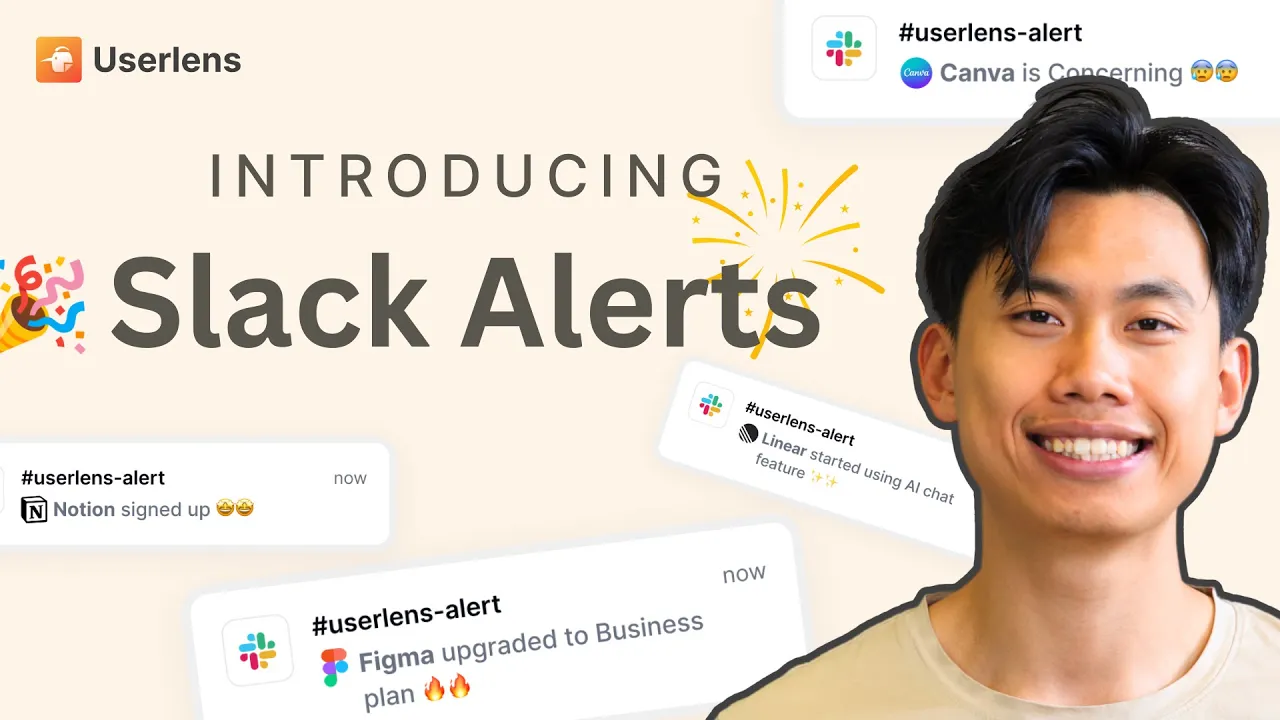
This is how Slack alerts work on Userlens:
Step 3: Turn Alerts into Proactive Engagement
An alert is only useful if it leads to meaningful action. When your team receives a churn risk alert, they should have a clear playbook for how to respond. This might include:
Personalized Outreach: For high-value accounts, a CSM can reach out directly to offer support, schedule a training session, or simply check in.
Automated Campaigns: For lower-tier accounts, an alert can trigger an automated email sequence or an in-app message that guides users back to valuable features they may have missed.
Targeted Education: If an alert shows that a customer isn't using a key feature, you can send them a tutorial or invite them to a webinar focused on that feature's benefits.
A positive customer experience accounts for over two-thirds of customer loyalty, and proactive outreach is a key part of that. When you spot churn risk using behavior data, you have a golden opportunity to engage customers and reinforce your product's value.
It's important to choose a tool that is easy to start using and that can quickly become a part of your workflow. Userlens is one example: unlike traditional product analytics tools that focus on aggregated user data, it provides account-level product analytics built for Customer Success teams. This focus allows CSMs to understand customer adoption, manage their book of business, and prevent churn with precision.
Key capabilities of Userlens include:
Instant Look into Activity Levels: Get a clear view of account and user-level usage patterns to see who is engaged and who is not.
AI-Driven Health Scores: Define exactly what counts as good or bad usage. Userlens' AI also takes into account historical usage and the bigger context.
Contextual Alerts: Send alerts directly to your team via tools like Slack, providing them with the context they need to act quickly.
Seamless Integrations: Connect with your CRM and other data sources to create a complete, 360-degree view of your customers.
Conclusion: Stop Reacting and Start Preventing Churn
Customer churn is one of the biggest threats to sustainable SaaS growth, but it doesn't have to be an uncontrollable force. By moving from a reactive to a proactive mindset, you can get ahead of churn before it happens.
The strategy is simple: track key usage indicators, set up real-time alerts to flag at-risk behavior, and empower your teams to act on those alerts with targeted, helpful engagement. It is important to remember that churn benchmarks can vary widely across different industries, so understanding where your business stands is important.
Investing in the right churn prevention tools is no longer a luxury—it's a necessity for growth. Adopting a proactive mindset and exploring platforms like Userlens will give your team the insights they need to turn at-risk customers into loyal advocates.
For any SaaS business, customer churn is a constant threat to growth and profitability. Losing customers means losing revenue, and the cost of acquiring a new customer is almost always higher than retaining an existing one.
For years, businesses have relied on reactive methods to understand churn, such as sending exit surveys after a customer has already cancelled their subscription. While this provides some insight, it's too late to save that customer.
The game has changed.
To truly get ahead of churn, you need to be proactive. This means using real-time usage analytics and alerts to identify at-risk customers before they even think about leaving.
Why Real-Time Data is the Key to Proactive Churn Prevention
The most effective churn prevention strategies shift the focus from being reactive (finding out why a customer left) to being proactive (identifying which customers are at risk while they are still active). Real-time data is the engine that powers this proactive approach. Instead of guessing, you can make data-driven decisions to save accounts.
The benefits of using real-time analytics are clear:
Spot Risks Faster: You can immediately detect important changes in how customers use your product, like sudden drops in engagement or key features being ignored. This allows you to intervene before a small issue becomes a reason to cancel.
Align Teams: When your customer success, product, and sales teams all work from the same up-to-the-minute data, everyone has a clear and consistent view of customer health. This creates a single source of truth that enables better collaboration. You can learn more about how real-time data sync boosts B2B SaaS analytics and improves team alignment.
Improve Efficiency: Customer Success Managers (CSMs) can stop spending hours manually pulling data from different systems and trying to piece together a customer's story. Real-time analytics automate this process, freeing up teams to focus on what they do best: building relationships and providing value to customers.
Top Usage-Based Indicators That Signal Churn Risk
Certain user behaviors are strong predictors that a customer may be unhappy and considering leaving. By monitoring these specific metrics, you can build an early-warning system for your business.
Declining Product and Feature Usage
A drop in how often customers use your product is one of the most reliable signs of churn risk. If a customer isn't logging in or engaging, they aren't getting value. Some key metrics to watch include:
Daily Active Users (DAU): A decline in the percentage of licensed users who log in daily is a major red flag.
Session Duration: If users are spending less time in your app during each session, it might mean they are struggling to find what they need or are losing interest.
Feature Adoption Rate: Pay close attention to the usage of your "stickiest" features—the ones that provide the most value. A drop-off here is a critical warning.
Modern churn prevention tools can provide visual heatmaps and dashboards to make spotting these changes effortless. These are just a few of the top churn risk indicators for B2B SaaS companies you should be tracking.
Lack of Core Feature Adoption
Customers sign up for your product to solve a specific problem. If they aren't using the core features designed to do that, they will never experience the full value of your solution. It is crucial to identify your product's "critical features"—those that correlate most strongly with customer loyalty and long-term retention.
If a customer isn't using the very features that likely led them to subscribe in the first place, they are at a high risk of churning. Understanding how feature usage predicts SaaS churn is fundamental to building a proactive retention strategy.
Stalled Account Growth and Inactivity
Churn risk isn't just about declining usage; a lack of growth can be just as telling, especially in a B2B context. Signs of a stalled or stagnant account include:
No new users being added to the account over time.
No exploration of advanced features or new modules.
License utilization—the number of paid seats being used—remaining flat or low.
This is especially important because account-wide health matters. For example, B2B churn rates are significantly higher when a key decision-maker or champion leaves a company, making it critical to have broad adoption across the account.
How to Build a Real-Time Churn Alert System
Knowing the warning signs is the first step. The next is to build a system that automatically alerts you to them. Here’s a practical guide to implementing a proactive churn prevention strategy.
Step 1: Define Usage-Based Health Scores
A customer health score is a single metric that gives you an at-a-glance understanding of an account's risk level. This score is typically created by combining and weighting different data points, such as:
Login frequency
Feature adoption rates
Number of support tickets
Net Promoter Score (NPS)
While you can create these scores manually, modern churn prevention tools like Userlens use AI to create dynamic health scores. This approach simplifies the process and provides a more accurate, real-time picture of customer health. Adopting a usage-based risk scoring for SaaS churn model is a powerful way to prioritize your efforts.
Step 2: Set Up Automated, Real-Time Alerts
Once you have defined your health scores and key risk indicators, the next step is to create automated alerts that notify your team the moment a negative trend is detected. Examples of reasons for alerts include:
"Notify the CSM when a high-value account's health score goes from Healthy to Concerning."
"Create a Slack alert if a designated power user has not logged in for 14 consecutive days."
"Trigger a notification if a customer's overall usage drops by 50% compared to their 30-day average."
These alerts are a cornerstone of proactive retention, as they enable teams to act instantly. When tied to smart workflows, you have a powerful system that helps you discover ways to reduce B2B SaaS customer churn.
This is how Slack alerts work on Userlens:
Step 3: Turn Alerts into Proactive Engagement
An alert is only useful if it leads to meaningful action. When your team receives a churn risk alert, they should have a clear playbook for how to respond. This might include:
Personalized Outreach: For high-value accounts, a CSM can reach out directly to offer support, schedule a training session, or simply check in.
Automated Campaigns: For lower-tier accounts, an alert can trigger an automated email sequence or an in-app message that guides users back to valuable features they may have missed.
Targeted Education: If an alert shows that a customer isn't using a key feature, you can send them a tutorial or invite them to a webinar focused on that feature's benefits.
A positive customer experience accounts for over two-thirds of customer loyalty, and proactive outreach is a key part of that. When you spot churn risk using behavior data, you have a golden opportunity to engage customers and reinforce your product's value.
It's important to choose a tool that is easy to start using and that can quickly become a part of your workflow. Userlens is one example: unlike traditional product analytics tools that focus on aggregated user data, it provides account-level product analytics built for Customer Success teams. This focus allows CSMs to understand customer adoption, manage their book of business, and prevent churn with precision.
Key capabilities of Userlens include:
Instant Look into Activity Levels: Get a clear view of account and user-level usage patterns to see who is engaged and who is not.
AI-Driven Health Scores: Define exactly what counts as good or bad usage. Userlens' AI also takes into account historical usage and the bigger context.
Contextual Alerts: Send alerts directly to your team via tools like Slack, providing them with the context they need to act quickly.
Seamless Integrations: Connect with your CRM and other data sources to create a complete, 360-degree view of your customers.
Conclusion: Stop Reacting and Start Preventing Churn
Customer churn is one of the biggest threats to sustainable SaaS growth, but it doesn't have to be an uncontrollable force. By moving from a reactive to a proactive mindset, you can get ahead of churn before it happens.
The strategy is simple: track key usage indicators, set up real-time alerts to flag at-risk behavior, and empower your teams to act on those alerts with targeted, helpful engagement. It is important to remember that churn benchmarks can vary widely across different industries, so understanding where your business stands is important.
Investing in the right churn prevention tools is no longer a luxury—it's a necessity for growth. Adopting a proactive mindset and exploring platforms like Userlens will give your team the insights they need to turn at-risk customers into loyal advocates.
© All rights reserved. Userlens 2026
© All rights reserved. Userlens 2026
© All rights reserved. Userlens 2026