Boost Retention with Customer Success Analytics Software
Boost Retention with Customer Success Analytics Software
Published

Lucia Ordonez
Marketing Intern
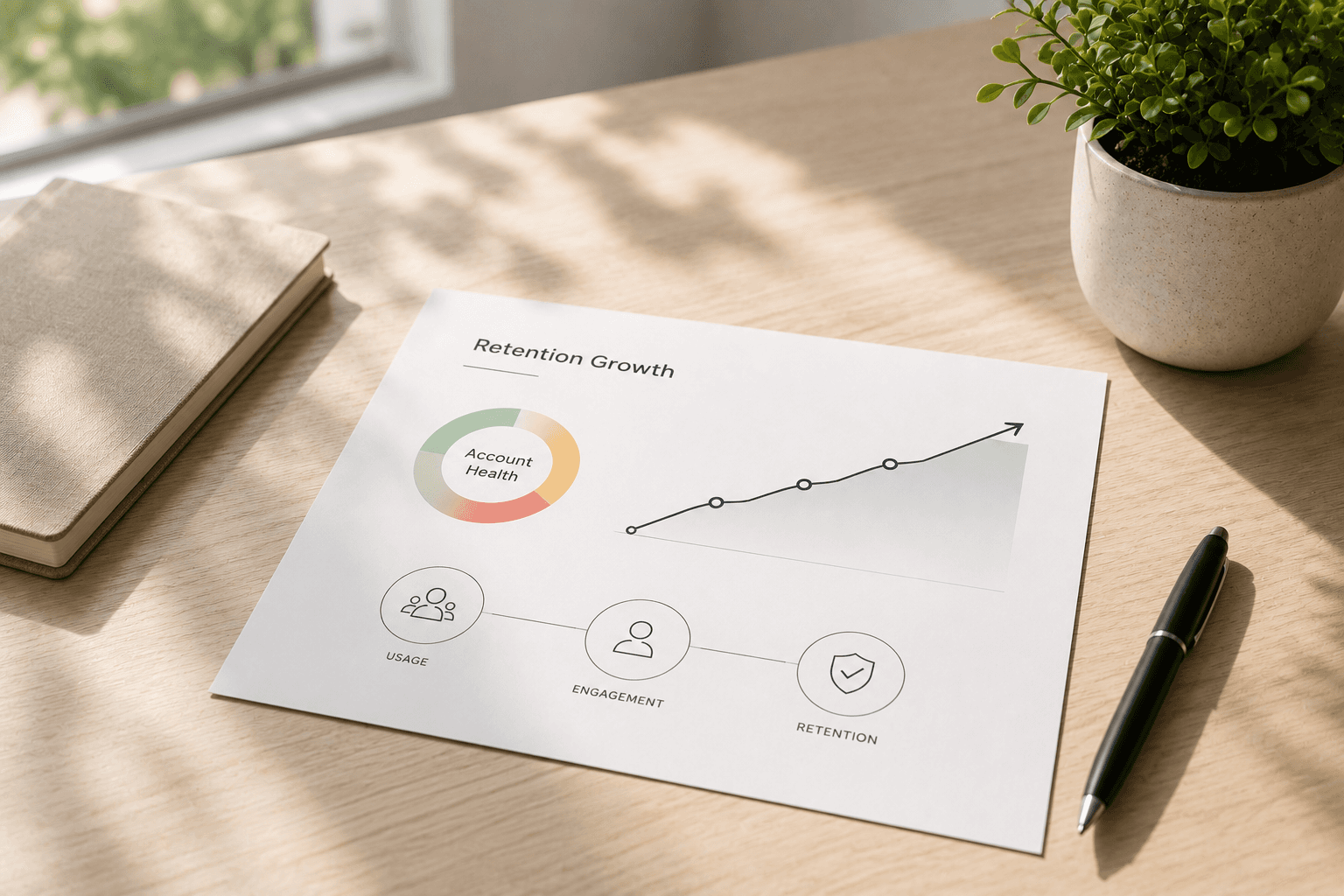
Relying on generic BI tools and a CRM to manage retention is a losing strategy for B2B SaaS companies. To get proactive about renewals, Customer Success teams need predictive, account-level intelligence that signals risk and opportunity. This is the exact function of customer success analytics software, a purpose-built solution that turns disparate data into a clear path for boosting retention.
Why Traditional Tools Fail at Proactive Retention
Customer Success teams that operate from their CRM and general business intelligence tools are always a step behind. Platforms like Salesforce provide a record of past interactions, while BI tools like Tableau visualize historical trends. Both provide lagging indicators snapshots of what has already happened, not what is happening right now.
The core problem is data silos. Critical information about an account’s health is scattered across multiple systems:
Product analytics tools like Mixpanel or Amplitude hold usage data.
CRMs like HubSpot or Salesforce contain commercial history and contacts.
Support and ticketing platforms track ticket volume and sentiment.
Data warehouses like Snowflake house the raw, underlying data.
Stitching this data together requires manual effort from the Customer Success Manager (CSM) or dedicated resources from a data team. This process is slow, inefficient, and demonstrates why traditional tools are not built for the real-time needs of CS teams. They fail to provide the proactive insights that drive retention.
Unify Your Data for a 360-Degree Account View
The primary function of customer success analytics software is to serve as a single source of truth for all account-related data. These platforms integrate directly with the tools your company already uses, unifying product usage, CRM data, and support tickets into a single, intuitive platform. This creates a complete, 360-degree view of every account.
For a CSM, this means no more toggling between tabs or asking the data team for a report. All the information needed to understand an account’s journey, health, and behavior is consolidated and accessible. With features that support secure, role-based analytics access, this unified view empowers everyone from the frontline CSM to the VP of Customer Success with the right information.
This efficiency gain is not theoretical.By connecting their CRM and product analytics tools to Userlens, CS teams typically eliminate the tab-toggling and manual data assembly that consumes prep time before client check-ins. CSMs could spend less time hunting for data and more time acting on it.
Move from Reactive Support to Proactive Intervention
With a unified data foundation, CS teams can shift from a reactive posture to a proactive one. Instead of waiting for an account to complain or for a red flag to appear in the CRM, modern analytics tools use data to predict outcomes and guide intervention.
Predict Churn with AI-Powered Health Scoring
Static, manually configured health scores are a relic of older customer success platforms. They rely on a handful of metrics and often fail to capture the nuanced signals of a deteriorating account relationship. Modern, LLM-native platforms automate this process with a dynamic AI Health Score that can predict customer churn with greater accuracy.
These scores are calculated by analyzing thousands of data points across an account’s entire history product usage, feature adoption, support ticket velocity, and more. At Userlens, our AI Health Score is recalculated automatically on a regular cadence, providing an early warning system that is constantly learning. This gives CSMs a crucial head start to intervene with at-risk accounts weeks or even months before the renewal conversation.
Identify Usage Drops Before They Become Problems
Product usage is the most powerful leading indicator of account health and future churn. A decline in activity is often the first sign of trouble. Customer success analytics software makes these trends visible at the account-level, allowing a CSM to spot them instantly.
Critical signals include:
A drop in overall activity or key feature adoption.
Declining seat utilization or a decrease in active users.
Key champions going inactive within the product.
Instead of requiring CSMs to write SQL queries or interpret complex dashboards, platforms like Userlens provide simple visual cues like Activity Dots to highlight these changes. This allows a CSM to see exactly which accounts are trending down and which users are at risk, turning complex product data into a simple, actionable workflow.
Uncover Expansion Opportunities with Data
Great customer success is not just about preventing churn; it is about driving growth. Analytics software is a powerful engine for identifying expansion opportunities and increasing Net Revenue Retention (NRR). By monitoring how accounts use the product, CSMs can spot clear, data-backed signals for upsells and cross-sells.
Examples of expansion signals include:
An account consistently hitting its plan limits for users or features.
An account showing high adoption of features that are packaged in a higher pricing tier.
An account rapidly adding users, signaling an opportunity for a larger license package.
This data-driven approach transforms the expansion conversation. Instead of making a generic pitch, a CSM can approach the account with concrete evidence of how they can get more value from the product, making the upsell a natural next step in the partnership.
Choosing the Right Customer Success Analytics Software
The market includes a wide range of customer success tools designed to boost retention and growthAll-in-one CS platforms bundle analytics with functions like automated playbooks and email campaigns. While these comprehensive tools can be effective, they often require lengthy implementations and may not offer the deep, account-level analytics that modern B2B SaaS teams need.
Userlens represents a new category of purpose-built customer success analytics software. We are an LLM-native and renewal-aware platform designed specifically for the workflows of CS and GTM teams at B2B SaaS companies. Our focus is not on replacing your entire tech stack but on providing a powerful, agentic intelligence layer that unifies your existing data and makes it actionable. By choosing a dedicated customer success solution that minimizes manual effort, teams see faster time-to-value.
This approach delivers tangible results. Purpose-built analytics directly improves team efficiency by eliminating manual reporting and surfacing the signals that matter, allowing each CSM to manage more accounts without losing depth.
Frequently Asked Questions (FAQ)
How is customer success analytics software different from our CRM?
A CRM stores historical and commercial data, telling you what has happened with an account. Customer success analytics software integrates that data with real-time product usage and other signals to predict what will happen, allowing your team to be proactive.
Can my non-technical CSMs actually use this kind of software without data team help?
Yes. Modern platforms like Userlens are designed for business users, not data scientists. They use an intuitive interface, visual cues, and plain-language summaries to make complex data accessible, empowering CSMs to find insights themselves without writing code.
What kind of data is most important for predicting churn?
While many factors matter, product usage data is the strongest predictor of churn. A decline in user activity, feature adoption, and seat utilization are often the earliest signs that an account is disengaging and at risk of non-renewal.
How quickly can we see ROI from implementing a CS analytics tool?
With a purpose-built tool that integrates with your existing systems, you can see ROI within the first quarter. The immediate efficiency gains from reduced manual reporting, coupled with the ability to save just one or two at-risk accounts, often delivers a return on investment in months.
Make Retention Your Most Predictable Revenue Driver
To scale efficiently, Customer Success teams must move beyond manual workflows and reactive fire-fighting. Last-minute heroics before a renewal are not a scalable strategy. True retention excellence comes from a systematic, data-driven approach to understanding and serving your accounts.
Customer success analytics software provides the unified data, proactive alerts, and account-level intelligence that B2B SaaS teams need to operate effectively. It transforms the CS function from a cost center focused on support into a predictable revenue driver focused on retention and expansion. By empowering your CSMs with the right insights at the right time, you enable them to build stronger relationships, mitigate risk, and secure renewals long before they are in jeopardy.
See how Userlens gives your team the predictive, account-level insights needed to drive retention. Explore our pricing and features.
Conclusion
Customer success analytics software is no longer a nice-to-have for B2B SaaS companies. It is a strategic necessity.By unifying your data, predicting churn before it happens, and surfacing expansion opportunities, these purpose-built platforms transform how CS teams operate. The result is a more efficient team, stronger account relationships, and a retention motion that consistently drives predictable revenue growth.
Relying on generic BI tools and a CRM to manage retention is a losing strategy for B2B SaaS companies. To get proactive about renewals, Customer Success teams need predictive, account-level intelligence that signals risk and opportunity. This is the exact function of customer success analytics software, a purpose-built solution that turns disparate data into a clear path for boosting retention.
Why Traditional Tools Fail at Proactive Retention
Customer Success teams that operate from their CRM and general business intelligence tools are always a step behind. Platforms like Salesforce provide a record of past interactions, while BI tools like Tableau visualize historical trends. Both provide lagging indicators snapshots of what has already happened, not what is happening right now.
The core problem is data silos. Critical information about an account’s health is scattered across multiple systems:
Product analytics tools like Mixpanel or Amplitude hold usage data.
CRMs like HubSpot or Salesforce contain commercial history and contacts.
Support and ticketing platforms track ticket volume and sentiment.
Data warehouses like Snowflake house the raw, underlying data.
Stitching this data together requires manual effort from the Customer Success Manager (CSM) or dedicated resources from a data team. This process is slow, inefficient, and demonstrates why traditional tools are not built for the real-time needs of CS teams. They fail to provide the proactive insights that drive retention.
Unify Your Data for a 360-Degree Account View
The primary function of customer success analytics software is to serve as a single source of truth for all account-related data. These platforms integrate directly with the tools your company already uses, unifying product usage, CRM data, and support tickets into a single, intuitive platform. This creates a complete, 360-degree view of every account.
For a CSM, this means no more toggling between tabs or asking the data team for a report. All the information needed to understand an account’s journey, health, and behavior is consolidated and accessible. With features that support secure, role-based analytics access, this unified view empowers everyone from the frontline CSM to the VP of Customer Success with the right information.
This efficiency gain is not theoretical.By connecting their CRM and product analytics tools to Userlens, CS teams typically eliminate the tab-toggling and manual data assembly that consumes prep time before client check-ins. CSMs could spend less time hunting for data and more time acting on it.
Move from Reactive Support to Proactive Intervention
With a unified data foundation, CS teams can shift from a reactive posture to a proactive one. Instead of waiting for an account to complain or for a red flag to appear in the CRM, modern analytics tools use data to predict outcomes and guide intervention.
Predict Churn with AI-Powered Health Scoring
Static, manually configured health scores are a relic of older customer success platforms. They rely on a handful of metrics and often fail to capture the nuanced signals of a deteriorating account relationship. Modern, LLM-native platforms automate this process with a dynamic AI Health Score that can predict customer churn with greater accuracy.
These scores are calculated by analyzing thousands of data points across an account’s entire history product usage, feature adoption, support ticket velocity, and more. At Userlens, our AI Health Score is recalculated automatically on a regular cadence, providing an early warning system that is constantly learning. This gives CSMs a crucial head start to intervene with at-risk accounts weeks or even months before the renewal conversation.
Identify Usage Drops Before They Become Problems
Product usage is the most powerful leading indicator of account health and future churn. A decline in activity is often the first sign of trouble. Customer success analytics software makes these trends visible at the account-level, allowing a CSM to spot them instantly.
Critical signals include:
A drop in overall activity or key feature adoption.
Declining seat utilization or a decrease in active users.
Key champions going inactive within the product.
Instead of requiring CSMs to write SQL queries or interpret complex dashboards, platforms like Userlens provide simple visual cues like Activity Dots to highlight these changes. This allows a CSM to see exactly which accounts are trending down and which users are at risk, turning complex product data into a simple, actionable workflow.
Uncover Expansion Opportunities with Data
Great customer success is not just about preventing churn; it is about driving growth. Analytics software is a powerful engine for identifying expansion opportunities and increasing Net Revenue Retention (NRR). By monitoring how accounts use the product, CSMs can spot clear, data-backed signals for upsells and cross-sells.
Examples of expansion signals include:
An account consistently hitting its plan limits for users or features.
An account showing high adoption of features that are packaged in a higher pricing tier.
An account rapidly adding users, signaling an opportunity for a larger license package.
This data-driven approach transforms the expansion conversation. Instead of making a generic pitch, a CSM can approach the account with concrete evidence of how they can get more value from the product, making the upsell a natural next step in the partnership.
Choosing the Right Customer Success Analytics Software
The market includes a wide range of customer success tools designed to boost retention and growthAll-in-one CS platforms bundle analytics with functions like automated playbooks and email campaigns. While these comprehensive tools can be effective, they often require lengthy implementations and may not offer the deep, account-level analytics that modern B2B SaaS teams need.
Userlens represents a new category of purpose-built customer success analytics software. We are an LLM-native and renewal-aware platform designed specifically for the workflows of CS and GTM teams at B2B SaaS companies. Our focus is not on replacing your entire tech stack but on providing a powerful, agentic intelligence layer that unifies your existing data and makes it actionable. By choosing a dedicated customer success solution that minimizes manual effort, teams see faster time-to-value.
This approach delivers tangible results. Purpose-built analytics directly improves team efficiency by eliminating manual reporting and surfacing the signals that matter, allowing each CSM to manage more accounts without losing depth.
Frequently Asked Questions (FAQ)
How is customer success analytics software different from our CRM?
A CRM stores historical and commercial data, telling you what has happened with an account. Customer success analytics software integrates that data with real-time product usage and other signals to predict what will happen, allowing your team to be proactive.
Can my non-technical CSMs actually use this kind of software without data team help?
Yes. Modern platforms like Userlens are designed for business users, not data scientists. They use an intuitive interface, visual cues, and plain-language summaries to make complex data accessible, empowering CSMs to find insights themselves without writing code.
What kind of data is most important for predicting churn?
While many factors matter, product usage data is the strongest predictor of churn. A decline in user activity, feature adoption, and seat utilization are often the earliest signs that an account is disengaging and at risk of non-renewal.
How quickly can we see ROI from implementing a CS analytics tool?
With a purpose-built tool that integrates with your existing systems, you can see ROI within the first quarter. The immediate efficiency gains from reduced manual reporting, coupled with the ability to save just one or two at-risk accounts, often delivers a return on investment in months.
Make Retention Your Most Predictable Revenue Driver
To scale efficiently, Customer Success teams must move beyond manual workflows and reactive fire-fighting. Last-minute heroics before a renewal are not a scalable strategy. True retention excellence comes from a systematic, data-driven approach to understanding and serving your accounts.
Customer success analytics software provides the unified data, proactive alerts, and account-level intelligence that B2B SaaS teams need to operate effectively. It transforms the CS function from a cost center focused on support into a predictable revenue driver focused on retention and expansion. By empowering your CSMs with the right insights at the right time, you enable them to build stronger relationships, mitigate risk, and secure renewals long before they are in jeopardy.
See how Userlens gives your team the predictive, account-level insights needed to drive retention. Explore our pricing and features.
Conclusion
Customer success analytics software is no longer a nice-to-have for B2B SaaS companies. It is a strategic necessity.By unifying your data, predicting churn before it happens, and surfacing expansion opportunities, these purpose-built platforms transform how CS teams operate. The result is a more efficient team, stronger account relationships, and a retention motion that consistently drives predictable revenue growth.
Help
support@userlens.io
© All rights reserved. Userlens 2026
Help
support@userlens.io
© All rights reserved. Userlens 2026
Help
support@userlens.io
© All rights reserved. Userlens 2026