Customer Health Scoring Software: Predict At‑Risk Accounts
Customer Health Scoring Software: Predict At‑Risk Accounts
Published

Lucia Ordonez
Marketing Intern
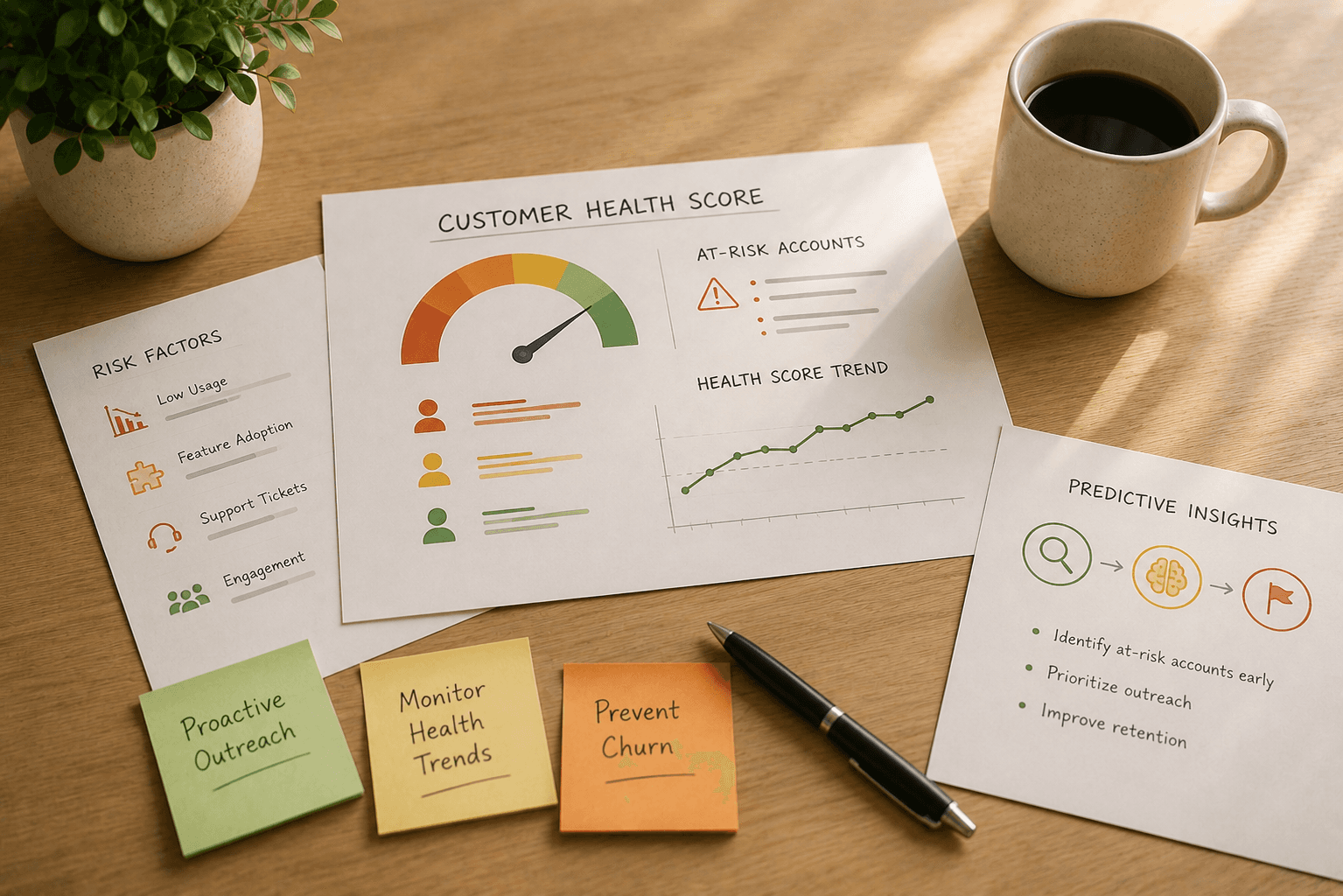
Manually tracking account health with spreadsheets and subjective check-ins makes churn a surprise, not a predictable outcome. For B2B SaaS companies, this reactive approach puts Net Revenue Retention (NRR) at risk every single quarter. Effective customer health scoring software ends the guesswork, arming your team to see which Q3 accounts are in trouble months before the renewal date.
Why Your Current Health Score Is a Lagging Indicator
Most health scores are not health scores; they are post-mortems. They are built on lagging indicators data points that only confirm a problem has already occurred. This fundamental flaw traps Customer Success teams in a reactive cycle of fire-fighting and makes accurate forecasting impossible.
Common but flawed lagging indicators include:
NPS scores: By the time an account submits a low Net Promoter Score, the dissatisfaction has taken root. The damage is done, and your team is starting from a deep deficit of trust and goodwill.
Support ticket volume: A sudden spike in tickets signals user frustration, but a sudden silence is often far worse. It means the account has likely disengaged and given up on finding value, a clear precursor to churn.
CSM sentiment: A "Green" status in your CRM creates a dangerous false sense of security. Without deep product usage data, even the best Customer Success Manager (CSM) is flying blind, unable to see the subtle disengagement that precedes churn.
Relying on these metrics forces CSMs to react to alerts for problems that began weeks or months ago. This is not a scalable strategy to predict churn or identify upsell opportunities.
Move from Reactive to Predictive with Modern Health Scoring
The solution is to adopt purpose-built customer health scoring software. This is not another dashboard to check; it is an active system that ingests multiple data streams to generate a forward-looking, predictive score for every account. The goal is not simply to see a red, yellow, or green status. It is to understand why an account has that score and what is likely to happen next, giving you the lead time to intervene effectively.
The Data That Powers Predictive Scoring
A reliable health score requires a holistic, account-level view. A score built on a single data source is a single point of failure. Modern customer success analytics software must combine several types of leading indicators to be trustworthy.
Product Usage Data: This is the ground truth of account health. Go beyond simple logins to measure the depth and breadth of feature adoption, changes in key workflow completion rates, and the activity levels of account champions.
Commercial Data: Integrating your CRM (e.g., Salesforce, HubSpot) adds crucial context. Data points like contract value, renewal date, and account tier help prioritize CSM effort on the highest-value, at-risk accounts.
Engagement History: Monitor the cadence of human interactions. Track the frequency of Quarterly Business Reviews (QBRs), email communications, and participation in webinars or training. A sudden drop-off in communication is a clear risk signal.
Support and Conversation Data: Userlens pulls in support tickets (via Pylon or Intercom), call notes (via Fireflies or Fathom), and Slack conversations to give CSMs a complete picture of account sentiment — not just product behavior. A customer going quiet in Slack while support tickets spike is a pattern that product data alone will never catch.
A score that omits commercial data might send CSMs chasing low-value accounts, while one without support data might miss the frustrations of a key enterprise account. A platform that fails to integrate these sources cannot deliver a truly predictive score; it only gives you a fraction of the story.
!A diagram showing multiple data sources like Product Usage, CRM, and Support Tickets flowing into a central health scoring engine, which then outputs a predictive score for a B2B SaaS account.
Key Features of Effective Health Scoring Software
When evaluating tools, look for specific capabilities that separate modern systems from older platforms. The ability to reduce customer churn software offers is a given; the real differentiator is how it empowers your team to act.
Automated Data Integration: The software must connect directly to your core systems your data warehouse, CRM, product analytics tools, support platforms, and meeting tools without a months-long, engineering-heavy implementation project. Userlens connects all of these out of the box, combining every signal into a single account-level view.
Customizable Scoring Models: Enterprise and SMB accounts have different markers of health. The platform must allow you to create distinct health models for different segments, product lines, and stages of the customer lifecycle.
Predictive Analytics: The system must use machine learning or LLM-native models to identify complex patterns that signal future risk. Static, "if-then" rules can't find the non-obvious correlations that precede churn.
Actionable Alerts & Dashboards: A low health score is noise without context. The software must show CSMs why the score dropped by surfacing the specific usage changes that triggered the alert, moving far beyond the capabilities of traditional tools.
Plain-English Explanations: The best platforms don't just show a score — they tell you why. Userlens generates a natural-language flag reason alongside every health score, such as "Previously engaged users have gone quiet" or "Activity dropped sharply in the last week," so CSMs can act immediately without digging through dashboards to understand what triggered a change.
How to Differentiate Between Health Scoring Tools
The market for customer success software is crowded. Many platforms, from broad suites like Gainsight and ChurnZero to specialized tools like Akita and Reptrics, offer health scoring. The methodology behind that score is what matters.
Most first-generation platforms rely on static, rules-based scoring. A CSM or RevOps leader manually defines triggers, such as, "Alert me if logins drop by 30%." This approach is rigid and only catches the obvious problems you already know to look for. It cannot uncover the "unknown unknowns"—the complex, multi-factor patterns that truly predict churn.
This leaves your team with a false sense of security, blind to the underlying risks that simmer for months before boiling over into a renewal crisis.
In contrast, purpose-built software is designed for predictive intelligence. We designed Userlens to be LLM-native, meaning our models learn directly from your unique account data. The system identifies what healthy adoption looks like for your specific product and customer segments, then automatically flags deviations. This delivers the deep, account-level insights needed to manage renewals at scale a critical capability for teams at companies like our customer Quartr, where CSMs each manage hundreds of accounts.
Userlens: From Health Score to Retention Strategy
Userlens addresses the core problem: CSMs are buried in data but starved for insight. Our platform provides an agentic layer that turns raw data into proactive guidance.
The Userlens Agent is the engine of our platform. It acts as an AI analyst for your team, continuously monitoring all account activity across product usage, your CRM, support tickets, and even Slack conversations.
Our LLM-native model analyzes this unified data stream to generate a predictive health score that is renewal-aware it understands an account’s lifecycle context and flags risk relative to its upcoming renewal date. When the Agent identifies an at-risk account, it does not just send another generic alert. It is MCP-native, delivering a concise summary directly into your team's existing AI tools like Claude or ChatGPT, explaining why the account is at risk and suggesting concrete steps for re-engagement.
This transforms a health score from a passive number on a dashboard into an active, strategic tool for retention.
Behind the score, Userlens tracks several concrete signals: a consecutive-flags counter that shows how many periods in a row an account has been at risk, cohort-based alerting that fires the moment an account enters a defined at-risk segment, and a Slack-native alert delivery that routes the right notification to the right CSM in real time no dashboard login required.
"Userlens gives us a single account-level view of product usage, CRM, meetings, and support tickets. The agent reads it all and surfaces what matters. We can now be proactive about renewals, not reactive." VP of Customer Success, AhaSlides
Frequently Asked Questions (FAQ)
Q: How is a predictive health score different from a rules-based one? A: A rules-based score checks against static thresholds you define, like "logins dropped by 20%." A predictive score uses an LLM to analyze all data simultaneously to find complex patterns that signal future churn, even ones you would not think to look for. This allows you to identify escalation risks months in advance, not just after a negative event occurs.
Q: What data sources do I need to implement customer health scoring software? A: At a minimum, you need product usage data from a source like a data warehouse or Segment. For the most accurate score, you must also integrate your CRM for commercial context and your ticketing system for support history. The goal is a complete, account-level view.
Q: Can customer health scores really predict which accounts will churn? A: Yes, when they are based on leading indicators like product usage. Modern health scoring software analyzes changes in feature adoption and user engagement to identify accounts that are quietly disengaging, even if they are not submitting support tickets. This enables CSMs to intervene before the account has already made a decision to leave.
Q: How do I get my CSMs to trust an automated health score? A: Trust comes from transparency and actionability. The software must show why an account is scored a certain way by surfacing the underlying data points. When CSMs see that the scores accurately flag at-risk accounts and help them save renewals, adoption follows quickly.
Q: How does Userlens surface account risk to CSMs? A: Userlens uses a combination of automated health scoring, cohort-based signals, and a conversational AI Agent. Each company receives a health score on a 1–10 scale with a plain-English reason explaining why the score changed. When an account enters a predefined at-risk cohort for example, "no product activity in 14 days with a renewal within 60 days" an alert fires instantly to the assigned CSM via Slack. CSMs can also ask the AI Agent directly: "What happened to this account last week?" and get a synthesized answer drawing from product usage, CRM, call notes, and support tickets.
Conclusion
Stop relying on lagging indicators and subjective feelings to manage renewals. The era of reactive, fire-fighting customer success is over.
Modern customer health scoring software transforms customer success from a cost center into a proactive, revenue-driving engine. By arming your CSMs with predictive, renewal-aware insights, you empower them to focus their time on the accounts that need it most. This leads to better retention, more accurate forecasting, and a far more efficient organization.
The goal is to make every renewal conversation a formality, not a last-minute negotiation.
See how the Userlens Agent can predict churn and surface opportunities in your accounts.
Manually tracking account health with spreadsheets and subjective check-ins makes churn a surprise, not a predictable outcome. For B2B SaaS companies, this reactive approach puts Net Revenue Retention (NRR) at risk every single quarter. Effective customer health scoring software ends the guesswork, arming your team to see which Q3 accounts are in trouble months before the renewal date.
Why Your Current Health Score Is a Lagging Indicator
Most health scores are not health scores; they are post-mortems. They are built on lagging indicators data points that only confirm a problem has already occurred. This fundamental flaw traps Customer Success teams in a reactive cycle of fire-fighting and makes accurate forecasting impossible.
Common but flawed lagging indicators include:
NPS scores: By the time an account submits a low Net Promoter Score, the dissatisfaction has taken root. The damage is done, and your team is starting from a deep deficit of trust and goodwill.
Support ticket volume: A sudden spike in tickets signals user frustration, but a sudden silence is often far worse. It means the account has likely disengaged and given up on finding value, a clear precursor to churn.
CSM sentiment: A "Green" status in your CRM creates a dangerous false sense of security. Without deep product usage data, even the best Customer Success Manager (CSM) is flying blind, unable to see the subtle disengagement that precedes churn.
Relying on these metrics forces CSMs to react to alerts for problems that began weeks or months ago. This is not a scalable strategy to predict churn or identify upsell opportunities.
Move from Reactive to Predictive with Modern Health Scoring
The solution is to adopt purpose-built customer health scoring software. This is not another dashboard to check; it is an active system that ingests multiple data streams to generate a forward-looking, predictive score for every account. The goal is not simply to see a red, yellow, or green status. It is to understand why an account has that score and what is likely to happen next, giving you the lead time to intervene effectively.
The Data That Powers Predictive Scoring
A reliable health score requires a holistic, account-level view. A score built on a single data source is a single point of failure. Modern customer success analytics software must combine several types of leading indicators to be trustworthy.
Product Usage Data: This is the ground truth of account health. Go beyond simple logins to measure the depth and breadth of feature adoption, changes in key workflow completion rates, and the activity levels of account champions.
Commercial Data: Integrating your CRM (e.g., Salesforce, HubSpot) adds crucial context. Data points like contract value, renewal date, and account tier help prioritize CSM effort on the highest-value, at-risk accounts.
Engagement History: Monitor the cadence of human interactions. Track the frequency of Quarterly Business Reviews (QBRs), email communications, and participation in webinars or training. A sudden drop-off in communication is a clear risk signal.
Support and Conversation Data: Userlens pulls in support tickets (via Pylon or Intercom), call notes (via Fireflies or Fathom), and Slack conversations to give CSMs a complete picture of account sentiment — not just product behavior. A customer going quiet in Slack while support tickets spike is a pattern that product data alone will never catch.
A score that omits commercial data might send CSMs chasing low-value accounts, while one without support data might miss the frustrations of a key enterprise account. A platform that fails to integrate these sources cannot deliver a truly predictive score; it only gives you a fraction of the story.
!A diagram showing multiple data sources like Product Usage, CRM, and Support Tickets flowing into a central health scoring engine, which then outputs a predictive score for a B2B SaaS account.
Key Features of Effective Health Scoring Software
When evaluating tools, look for specific capabilities that separate modern systems from older platforms. The ability to reduce customer churn software offers is a given; the real differentiator is how it empowers your team to act.
Automated Data Integration: The software must connect directly to your core systems your data warehouse, CRM, product analytics tools, support platforms, and meeting tools without a months-long, engineering-heavy implementation project. Userlens connects all of these out of the box, combining every signal into a single account-level view.
Customizable Scoring Models: Enterprise and SMB accounts have different markers of health. The platform must allow you to create distinct health models for different segments, product lines, and stages of the customer lifecycle.
Predictive Analytics: The system must use machine learning or LLM-native models to identify complex patterns that signal future risk. Static, "if-then" rules can't find the non-obvious correlations that precede churn.
Actionable Alerts & Dashboards: A low health score is noise without context. The software must show CSMs why the score dropped by surfacing the specific usage changes that triggered the alert, moving far beyond the capabilities of traditional tools.
Plain-English Explanations: The best platforms don't just show a score — they tell you why. Userlens generates a natural-language flag reason alongside every health score, such as "Previously engaged users have gone quiet" or "Activity dropped sharply in the last week," so CSMs can act immediately without digging through dashboards to understand what triggered a change.
How to Differentiate Between Health Scoring Tools
The market for customer success software is crowded. Many platforms, from broad suites like Gainsight and ChurnZero to specialized tools like Akita and Reptrics, offer health scoring. The methodology behind that score is what matters.
Most first-generation platforms rely on static, rules-based scoring. A CSM or RevOps leader manually defines triggers, such as, "Alert me if logins drop by 30%." This approach is rigid and only catches the obvious problems you already know to look for. It cannot uncover the "unknown unknowns"—the complex, multi-factor patterns that truly predict churn.
This leaves your team with a false sense of security, blind to the underlying risks that simmer for months before boiling over into a renewal crisis.
In contrast, purpose-built software is designed for predictive intelligence. We designed Userlens to be LLM-native, meaning our models learn directly from your unique account data. The system identifies what healthy adoption looks like for your specific product and customer segments, then automatically flags deviations. This delivers the deep, account-level insights needed to manage renewals at scale a critical capability for teams at companies like our customer Quartr, where CSMs each manage hundreds of accounts.
Userlens: From Health Score to Retention Strategy
Userlens addresses the core problem: CSMs are buried in data but starved for insight. Our platform provides an agentic layer that turns raw data into proactive guidance.
The Userlens Agent is the engine of our platform. It acts as an AI analyst for your team, continuously monitoring all account activity across product usage, your CRM, support tickets, and even Slack conversations.
Our LLM-native model analyzes this unified data stream to generate a predictive health score that is renewal-aware it understands an account’s lifecycle context and flags risk relative to its upcoming renewal date. When the Agent identifies an at-risk account, it does not just send another generic alert. It is MCP-native, delivering a concise summary directly into your team's existing AI tools like Claude or ChatGPT, explaining why the account is at risk and suggesting concrete steps for re-engagement.
This transforms a health score from a passive number on a dashboard into an active, strategic tool for retention.
Behind the score, Userlens tracks several concrete signals: a consecutive-flags counter that shows how many periods in a row an account has been at risk, cohort-based alerting that fires the moment an account enters a defined at-risk segment, and a Slack-native alert delivery that routes the right notification to the right CSM in real time no dashboard login required.
"Userlens gives us a single account-level view of product usage, CRM, meetings, and support tickets. The agent reads it all and surfaces what matters. We can now be proactive about renewals, not reactive." VP of Customer Success, AhaSlides
Frequently Asked Questions (FAQ)
Q: How is a predictive health score different from a rules-based one? A: A rules-based score checks against static thresholds you define, like "logins dropped by 20%." A predictive score uses an LLM to analyze all data simultaneously to find complex patterns that signal future churn, even ones you would not think to look for. This allows you to identify escalation risks months in advance, not just after a negative event occurs.
Q: What data sources do I need to implement customer health scoring software? A: At a minimum, you need product usage data from a source like a data warehouse or Segment. For the most accurate score, you must also integrate your CRM for commercial context and your ticketing system for support history. The goal is a complete, account-level view.
Q: Can customer health scores really predict which accounts will churn? A: Yes, when they are based on leading indicators like product usage. Modern health scoring software analyzes changes in feature adoption and user engagement to identify accounts that are quietly disengaging, even if they are not submitting support tickets. This enables CSMs to intervene before the account has already made a decision to leave.
Q: How do I get my CSMs to trust an automated health score? A: Trust comes from transparency and actionability. The software must show why an account is scored a certain way by surfacing the underlying data points. When CSMs see that the scores accurately flag at-risk accounts and help them save renewals, adoption follows quickly.
Q: How does Userlens surface account risk to CSMs? A: Userlens uses a combination of automated health scoring, cohort-based signals, and a conversational AI Agent. Each company receives a health score on a 1–10 scale with a plain-English reason explaining why the score changed. When an account enters a predefined at-risk cohort for example, "no product activity in 14 days with a renewal within 60 days" an alert fires instantly to the assigned CSM via Slack. CSMs can also ask the AI Agent directly: "What happened to this account last week?" and get a synthesized answer drawing from product usage, CRM, call notes, and support tickets.
Conclusion
Stop relying on lagging indicators and subjective feelings to manage renewals. The era of reactive, fire-fighting customer success is over.
Modern customer health scoring software transforms customer success from a cost center into a proactive, revenue-driving engine. By arming your CSMs with predictive, renewal-aware insights, you empower them to focus their time on the accounts that need it most. This leads to better retention, more accurate forecasting, and a far more efficient organization.
The goal is to make every renewal conversation a formality, not a last-minute negotiation.
See how the Userlens Agent can predict churn and surface opportunities in your accounts.
Help
support@userlens.io
© All rights reserved. Userlens 2026
Help
support@userlens.io
© All rights reserved. Userlens 2026
Help
support@userlens.io
© All rights reserved. Userlens 2026