How Account‑Based Product Analytics Cuts Churn for B2B SaaS
How Account‑Based Product Analytics Cuts Churn for B2B SaaS
Published

Lucia Ordonez
Marketing Intern
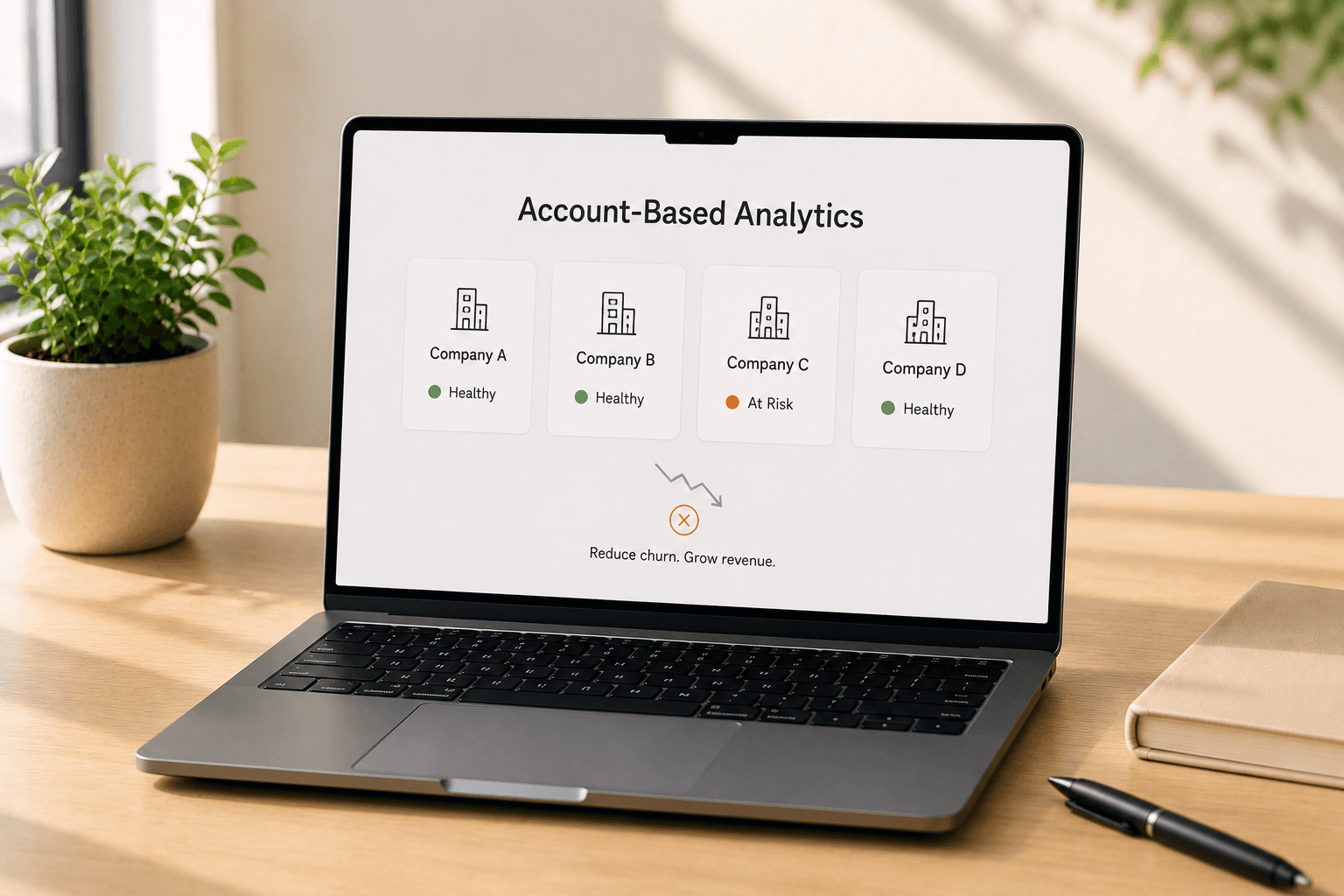
Traditional, user-level product analytics are insufficient for managing B2B SaaS churn. Your renewal decisions are made at the account level, yet your analytics tools are built to measure individual users, creating a critical blind spot. A handful of active users can easily mask a disengaged department, a missing champion, or a team that never truly onboarded—all silent indicators of a Q3 renewal that is already at risk.
This approach forces Customer Success teams to guess an account’s true health, creating a reactive fire-drill culture instead of a proactive, renewal-aware one.
Why Traditional Product Analytics Fails B2B SaaS
The fundamental problem with using traditional product analytics platforms for B2B SaaS is a mismatch in business models. Many popular tools were designed for B2C scenarios, where the user is the customer. In B2B SaaS, you sell to companies, and success is measured by the value delivered to the entire organization.
You do not renew users; you renew accounts.
An account can appear healthy based on superficial, user-level metrics. A single power user might generate thousands of events, creating the illusion of deep engagement. Meanwhile, the rest of the team—including the budget owner who signs the check—may have already abandoned the platform. This creates a dangerous false sense of security.
Customer Success Managers (CSMs) are then left to manually assemble a picture of account health. They stitch together data from their CRM, support tickets, call notes, and disjointed product usage reports. This process is time-consuming, prone to human error, and rarely provides a real-time view, which is precisely why B2B SaaS needs account-level analytics built for the CS workflow, not for product managers.
The Solution: A Shift to Account-Based Product Analytics
Account-based product analytics is the practice of aggregating and analyzing product usage data at the company or team level, not just for individual users. It is a necessary shift to move beyond lead-centric measurement and focus on the health of the entire account as industry research confirms. This method rolls up discrete user actions into a holistic view of the organization's engagement with your product.
Instead of tracking one user’s journey, you track the health of the entire organization. This allows Customer Success Managers to answer critical questions:
Is the account's overall usage trending up or down?
Are key features being adopted across multiple departments?
What percentage of paid seats are actively using the product?
Are our champions and decision-makers engaged?
This account-centric view provides a shared, objective truth about customer health. It aligns Customer Success, Product, and Sales teams around a single source of data, enabling them to make collaborative decisions based on how entire organizations connect product usage to revenue outcomes as SaaS revenue research shows. Aggregating individual user actions provides a far more comprehensive view of account health than traditional analytics ever could according to B2B analytics experts.
How Account-Level Insights Pinpoint Churn Risk in Real Time
Account-based product analytics moves CS teams from being reactive to proactive by surfacing clear, early warning signs of churn. By monitoring the right account-level metrics, you can identify risk long before the renewal conversation begins and implement a specific playbook to address it.
Spot Declining Usage Across the Entire Account
A single user logging off is noise; an entire account’s usage dropping is a signal. Account-level analytics lets you see organization-wide trends that are invisible at the user level.
The Signal:
A sustained drop in weekly active users across the entire account.
Decreased use of "sticky" features that correlate directly with value and retention.
A significant drop in overall activity. A clear alert is when an account’s overall usage drops by 50% compared to its 30-day average.
The Playbook: When you detect customer usage drops before they become churn, your CSM should immediately contact the account champion. The goal is not to accuse but to diagnose. Ask questions like, "I noticed your team's usage of the reporting feature has slowed. Has there been a change in your workflow we can help with?" This opens a value-based conversation instead of a defensive one.
Identify Stagnant Adoption and Low Seat Utilization
A lack of growth within an account is often a precursor to churn. If an account is not deepening its engagement with your product, it is likely not seeing enough value to justify renewing, let alone expanding.
The Signal:
Low license utilization, which is the percentage of paid seats being actively used. If an account pays for 100 seats but only 20 are active, they have a powerful argument for downgrading or churning.
No new user growth over several months. Healthy accounts expand organically; a lack of new team members being invited signals that your product is not becoming embedded in their organization.
Inactive champions who are critical for driving adoption. An alert that a key champion has been inactive for 14 consecutive days is an actionable signal that requires immediate outreach.
The Playbook: For low seat utilization, trigger an automated email campaign for inactive users that highlights a new or underused feature relevant to their role. For an inactive champion, the assigned CSM should reach out personally to check in, offering a strategy session or sharing a recent product update. This helps you prevent churn with real-time usage analytics and alerts by turning stagnant accounts into opportunities for value reinforcement.
Flag Ineffective Onboarding and Low Time-to-Value
Many churn decisions are cemented within the first 90 days. If a customer's entire team fails to onboard successfully and achieve a quick first win, they will struggle to see the long-term value in your product.
The Signal:
Low adoption of key setup features in the first 30-60 days. Did the account's teams complete the critical steps that lead to "aha" moments?
Teams not progressing beyond basic functionality. If an account is stuck using only surface-level features, they are not realizing the full value they pay for and are a significant churn risk.
The Playbook: Use account-level data to automatically flag teams that fail to hit key onboarding milestones within their first 30 days. The CSM can then proactively schedule a targeted workshop or send a guide on advanced features. Improving this initial experience is one of the most effective ways to reduce B2B SaaS customer churn before it takes root, as poor onboarding is a leading indicator of a future cancellation as churn reduction studies show.
Operationalize Churn Prevention with a Purpose-Built Platform
Identifying these churn signals is only half the battle. To act on them, CS teams need a platform that operationalizes account-based product analytics within their daily workflow. This is where a purpose-built tool is essential.
Userlens is an LLM-native customer success platform designed to provide B2B SaaS companies with actionable, account-level intelligence. Unlike generic analytics tools that require a data team to configure and interpret, Userlens gives CSMs the insights they need out of the box. For instance, by using Userlens to monitor account-level feature adoption, AhaSlides identified and re-engaged over 30 at-risk accounts in Q2, preventing potential churn before renewal conversations began.
Our platform consolidates product usage, CRM data, support tickets, and Slack conversations into a single, unified view of account health.The LLM-native agent analyzes engagement patterns for each account, recalculates health scores on a regular cadence, and surfaces meaningful changes.
When a risk is detected—like a champion going quiet or a sudden drop in core feature usage. Userlens sends an alert directly into Slack or your team's preferred workspace, either in real-time or as a periodic digest. This is how you turn alerts into action and re-engage at-risk customers. Because Userlens integrates with the tools you already use—from Salesforce and HubSpot to product analytics platforms like Mixpanel and Amplitude—you can gain account-level visibility without a complex re-instrumentation project.
Frequently Asked Questions (FAQ)
How is account-based product analytics different from standard account views in Whiletraditional analytics tools?
Standarde Amplitude offer account-level grouping, they are fundamentally user-centric platforms retrofitted for B2B. A true account-based analytics solution is purpose-built to aggregate all signals—usage, CRM data, support tickets, meetings—into a holistic view of account health, designed specifically for B2B Customer Success workflows.
What are the most important account-level metrics for predicting B2B SaaS churn?
The most critical metrics are trends in overall usage, depth of feature adoption (especially "sticky" features), license utilization rate, and the activity level of key champions or decision-makers. A sudden negative change in any of these is a strong predictor of churn risk.
How can my non-technical CS team start using product analytics without waiting for engineering?
Adopt a purpose-built platform like Userlens that integrates with your existing data sources. These tools are designed for CSMs, not data scientists, and provide out-of-the-box health scores and alerts that are easy to understand and act on immediately, without writing code or SQL.
Can I set up alerts for when a key decision-maker in an account goes inactive?
Yes. A robust account-based analytics platform lets you track the activity of key users within an account. With Userlens, you can monitor individual user engagement through computed traits and cohorts, and set up alerts when key contacts show signs of disengagement, such as dropping out of an active-users cohort.
Conclusion
Relying on user-level analytics for B2B churn prevention is a flawed strategy that guarantees you will be caught by surprise. It creates dangerous blind spots by hiding the account-wide disengagement that precedes a decision not to renew.
To get ahead of churn, you must shift your focus to an account-based view. This approach provides the clarity needed to see true product engagement, adoption depth, and overall account health. It surfaces the objective signals of risk long before a customer vocalizes their dissatisfaction.
The most effective way to implement this strategy is with a purpose-built platform that translates complex usage data into simple, actionable alerts for your Customer Success team. Stop reacting to fires and start building a proactive, renewal-aware CS motion.
See how Userlens provides the account intelligence to get ahead of churn. Get a demo today.
Traditional, user-level product analytics are insufficient for managing B2B SaaS churn. Your renewal decisions are made at the account level, yet your analytics tools are built to measure individual users, creating a critical blind spot. A handful of active users can easily mask a disengaged department, a missing champion, or a team that never truly onboarded—all silent indicators of a Q3 renewal that is already at risk.
This approach forces Customer Success teams to guess an account’s true health, creating a reactive fire-drill culture instead of a proactive, renewal-aware one.
Why Traditional Product Analytics Fails B2B SaaS
The fundamental problem with using traditional product analytics platforms for B2B SaaS is a mismatch in business models. Many popular tools were designed for B2C scenarios, where the user is the customer. In B2B SaaS, you sell to companies, and success is measured by the value delivered to the entire organization.
You do not renew users; you renew accounts.
An account can appear healthy based on superficial, user-level metrics. A single power user might generate thousands of events, creating the illusion of deep engagement. Meanwhile, the rest of the team—including the budget owner who signs the check—may have already abandoned the platform. This creates a dangerous false sense of security.
Customer Success Managers (CSMs) are then left to manually assemble a picture of account health. They stitch together data from their CRM, support tickets, call notes, and disjointed product usage reports. This process is time-consuming, prone to human error, and rarely provides a real-time view, which is precisely why B2B SaaS needs account-level analytics built for the CS workflow, not for product managers.
The Solution: A Shift to Account-Based Product Analytics
Account-based product analytics is the practice of aggregating and analyzing product usage data at the company or team level, not just for individual users. It is a necessary shift to move beyond lead-centric measurement and focus on the health of the entire account as industry research confirms. This method rolls up discrete user actions into a holistic view of the organization's engagement with your product.
Instead of tracking one user’s journey, you track the health of the entire organization. This allows Customer Success Managers to answer critical questions:
Is the account's overall usage trending up or down?
Are key features being adopted across multiple departments?
What percentage of paid seats are actively using the product?
Are our champions and decision-makers engaged?
This account-centric view provides a shared, objective truth about customer health. It aligns Customer Success, Product, and Sales teams around a single source of data, enabling them to make collaborative decisions based on how entire organizations connect product usage to revenue outcomes as SaaS revenue research shows. Aggregating individual user actions provides a far more comprehensive view of account health than traditional analytics ever could according to B2B analytics experts.
How Account-Level Insights Pinpoint Churn Risk in Real Time
Account-based product analytics moves CS teams from being reactive to proactive by surfacing clear, early warning signs of churn. By monitoring the right account-level metrics, you can identify risk long before the renewal conversation begins and implement a specific playbook to address it.
Spot Declining Usage Across the Entire Account
A single user logging off is noise; an entire account’s usage dropping is a signal. Account-level analytics lets you see organization-wide trends that are invisible at the user level.
The Signal:
A sustained drop in weekly active users across the entire account.
Decreased use of "sticky" features that correlate directly with value and retention.
A significant drop in overall activity. A clear alert is when an account’s overall usage drops by 50% compared to its 30-day average.
The Playbook: When you detect customer usage drops before they become churn, your CSM should immediately contact the account champion. The goal is not to accuse but to diagnose. Ask questions like, "I noticed your team's usage of the reporting feature has slowed. Has there been a change in your workflow we can help with?" This opens a value-based conversation instead of a defensive one.
Identify Stagnant Adoption and Low Seat Utilization
A lack of growth within an account is often a precursor to churn. If an account is not deepening its engagement with your product, it is likely not seeing enough value to justify renewing, let alone expanding.
The Signal:
Low license utilization, which is the percentage of paid seats being actively used. If an account pays for 100 seats but only 20 are active, they have a powerful argument for downgrading or churning.
No new user growth over several months. Healthy accounts expand organically; a lack of new team members being invited signals that your product is not becoming embedded in their organization.
Inactive champions who are critical for driving adoption. An alert that a key champion has been inactive for 14 consecutive days is an actionable signal that requires immediate outreach.
The Playbook: For low seat utilization, trigger an automated email campaign for inactive users that highlights a new or underused feature relevant to their role. For an inactive champion, the assigned CSM should reach out personally to check in, offering a strategy session or sharing a recent product update. This helps you prevent churn with real-time usage analytics and alerts by turning stagnant accounts into opportunities for value reinforcement.
Flag Ineffective Onboarding and Low Time-to-Value
Many churn decisions are cemented within the first 90 days. If a customer's entire team fails to onboard successfully and achieve a quick first win, they will struggle to see the long-term value in your product.
The Signal:
Low adoption of key setup features in the first 30-60 days. Did the account's teams complete the critical steps that lead to "aha" moments?
Teams not progressing beyond basic functionality. If an account is stuck using only surface-level features, they are not realizing the full value they pay for and are a significant churn risk.
The Playbook: Use account-level data to automatically flag teams that fail to hit key onboarding milestones within their first 30 days. The CSM can then proactively schedule a targeted workshop or send a guide on advanced features. Improving this initial experience is one of the most effective ways to reduce B2B SaaS customer churn before it takes root, as poor onboarding is a leading indicator of a future cancellation as churn reduction studies show.
Operationalize Churn Prevention with a Purpose-Built Platform
Identifying these churn signals is only half the battle. To act on them, CS teams need a platform that operationalizes account-based product analytics within their daily workflow. This is where a purpose-built tool is essential.
Userlens is an LLM-native customer success platform designed to provide B2B SaaS companies with actionable, account-level intelligence. Unlike generic analytics tools that require a data team to configure and interpret, Userlens gives CSMs the insights they need out of the box. For instance, by using Userlens to monitor account-level feature adoption, AhaSlides identified and re-engaged over 30 at-risk accounts in Q2, preventing potential churn before renewal conversations began.
Our platform consolidates product usage, CRM data, support tickets, and Slack conversations into a single, unified view of account health.The LLM-native agent analyzes engagement patterns for each account, recalculates health scores on a regular cadence, and surfaces meaningful changes.
When a risk is detected—like a champion going quiet or a sudden drop in core feature usage. Userlens sends an alert directly into Slack or your team's preferred workspace, either in real-time or as a periodic digest. This is how you turn alerts into action and re-engage at-risk customers. Because Userlens integrates with the tools you already use—from Salesforce and HubSpot to product analytics platforms like Mixpanel and Amplitude—you can gain account-level visibility without a complex re-instrumentation project.
Frequently Asked Questions (FAQ)
How is account-based product analytics different from standard account views in Whiletraditional analytics tools?
Standarde Amplitude offer account-level grouping, they are fundamentally user-centric platforms retrofitted for B2B. A true account-based analytics solution is purpose-built to aggregate all signals—usage, CRM data, support tickets, meetings—into a holistic view of account health, designed specifically for B2B Customer Success workflows.
What are the most important account-level metrics for predicting B2B SaaS churn?
The most critical metrics are trends in overall usage, depth of feature adoption (especially "sticky" features), license utilization rate, and the activity level of key champions or decision-makers. A sudden negative change in any of these is a strong predictor of churn risk.
How can my non-technical CS team start using product analytics without waiting for engineering?
Adopt a purpose-built platform like Userlens that integrates with your existing data sources. These tools are designed for CSMs, not data scientists, and provide out-of-the-box health scores and alerts that are easy to understand and act on immediately, without writing code or SQL.
Can I set up alerts for when a key decision-maker in an account goes inactive?
Yes. A robust account-based analytics platform lets you track the activity of key users within an account. With Userlens, you can monitor individual user engagement through computed traits and cohorts, and set up alerts when key contacts show signs of disengagement, such as dropping out of an active-users cohort.
Conclusion
Relying on user-level analytics for B2B churn prevention is a flawed strategy that guarantees you will be caught by surprise. It creates dangerous blind spots by hiding the account-wide disengagement that precedes a decision not to renew.
To get ahead of churn, you must shift your focus to an account-based view. This approach provides the clarity needed to see true product engagement, adoption depth, and overall account health. It surfaces the objective signals of risk long before a customer vocalizes their dissatisfaction.
The most effective way to implement this strategy is with a purpose-built platform that translates complex usage data into simple, actionable alerts for your Customer Success team. Stop reacting to fires and start building a proactive, renewal-aware CS motion.
See how Userlens provides the account intelligence to get ahead of churn. Get a demo today.
© All rights reserved. Userlens 2026
© All rights reserved. Userlens 2026
© All rights reserved. Userlens 2026